

Key Takeaways
- Enclomiphene is a SERM that may stimulate the body’s own LH and FSH pathway to raise testosterone, unlike TRT, which replaces testosterone from outside the body.
- It may be considered for selected men with low testosterone symptoms and blood tests suggesting secondary or functional hypogonadism, always after physician consultation and hormone testing.
- Clinical studies suggest enclomiphene can raise testosterone in selected men while being less suppressive to sperm production than testosterone therapy, though results are not guaranteed.
- Enclomiphene can still cause side effects such as mood changes or estradiol-related symptoms, so treatment requires blood testing and ongoing monitoring of hormone and safety markers.
Table of Contents
For men looking to buy enclomiphene in Thailand, the most important first step is not simply finding the medication, but confirming whether low testosterone is truly present and what is causing it. Enclomiphene may be considered for selected men who want to support natural testosterone production while preserving fertility potential.
Unlike testosterone replacement therapy, enclomiphene does not directly replace testosterone. It works by stimulating the body’s LH and FSH pathway, which can help the testes produce more testosterone in appropriate patients.
At H.U.M. Clinic in Bangkok, enclomiphene is available as 25 mg tablets in a 50-tablet box. The price is 8,500 THB per box. Treatment requires consultation with a physician and blood testing before starting, because enclomiphene is not suitable for every type of low testosterone.
H.U.M. Clinic provides doctor-supervised hormone evaluation, blood testing, treatment planning, and follow-up monitoring for men with low testosterone symptoms in Bangkok.
What Is Enclomiphene?
Enclomiphene is the trans-isomer of clomiphene citrate, a selective estrogen receptor modulator, or SERM. In men, it acts mainly at the hypothalamus and pituitary gland by reducing estrogen feedback, which can increase luteinizing hormone, or LH, and follicle-stimulating hormone, or FSH.
LH and FSH are important signals for testicular function. LH helps stimulate testosterone production, while FSH plays a role in sperm production. Because of this mechanism, enclomiphene may help selected men increase their own testosterone production while being less suppressive to fertility than direct testosterone replacement therapy.
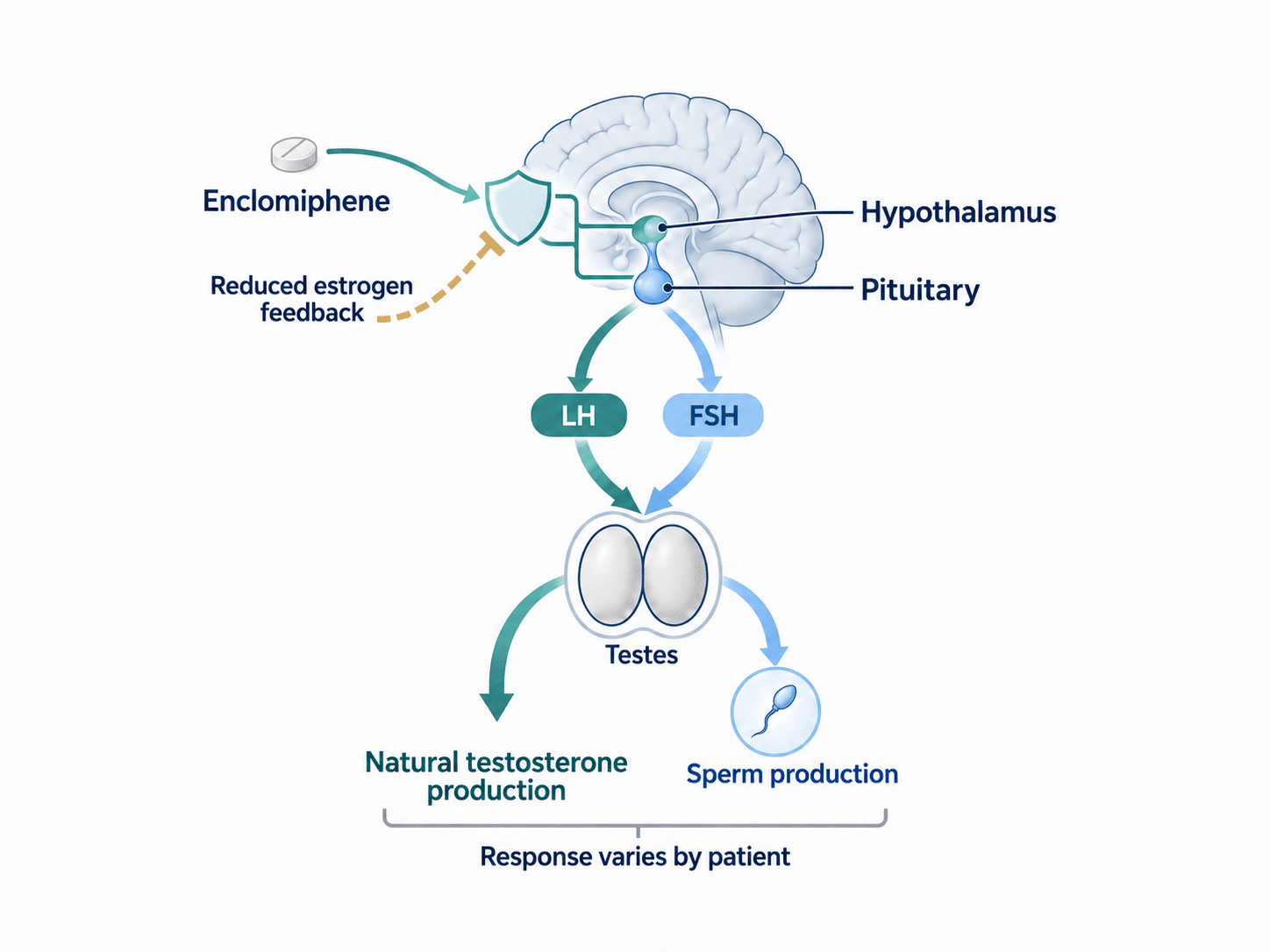
This is different from TRT. TRT provides testosterone from outside the body, which can suppress LH, FSH, and sperm production in some men. Enclomiphene instead aims to stimulate endogenous testosterone production through the body’s own hypothalamic-pituitary-testicular axis.
The mechanism of enclomiphene and testosterone production has been described in clinical reviews of enclomiphene for men with secondary hypogonadism.
Who May Consider Enclomiphene?
Enclomiphene may be considered for selected men who have symptoms of low testosterone together with blood test findings that suggest secondary or functional hypogonadism. This means the testes may still be able to produce testosterone, but the hormonal signal from the brain may be low or inappropriately normal.
A potential candidate may include men with low or borderline low total testosterone, low free testosterone, low or inappropriately normal LH and FSH, low libido, fatigue, low motivation, poor recovery, reduced morning erections, fertility goals, or preference for an oral option when medically appropriate.
Symptoms alone are not enough to start treatment. Fatigue, low libido, mood changes, poor sleep, obesity, thyroid disease, depression, medication effects, and overtraining can all overlap with low testosterone symptoms.
At H.U.M. Clinic, enclomiphene is considered only after physician consultation, hormone blood testing, medical history review, fertility discussion, and safety assessment. Men who are unsure whether their symptoms are related to testosterone can begin with a low testosterone evaluation in Bangkok before deciding whether enclomiphene, HCG, TRT, or another approach is appropriate.
Enclomiphene Price at H.U.M. Clinic
H.U.M. Clinic provides enclomiphene 25 mg tablets for selected patients after medical evaluation.
Current product format:
- Enclomiphene 25 mg tablet
- 50 tablets per box
- Price: 8,500 THB per box
- Physician consultation required
- Blood testing required before and during treatment
The dosing schedule should be decided by the physician based on testosterone level, LH, FSH, estradiol, SHBG, symptoms, fertility goals, and safety markers.
Patients should not self-adjust the dose or combine enclomiphene with testosterone, HCG, aromatase inhibitors, anabolic steroids, or other hormone-related medications without medical supervision.
Patients who want to discuss whether enclomiphene is appropriate can book a consultation with our doctor for hormone review and blood test planning.
Expected Testosterone Response
Clinical studies suggest that enclomiphene can increase total testosterone in selected men with secondary hypogonadism by stimulating LH and FSH production. In one study, men receiving enclomiphene 25 mg daily reached a mean total testosterone level of about 604 ng/dL after 6 weeks, as reported in an enclomiphene 25 mg testosterone increase study.
Enclomiphene may also be useful to discuss for men who want to improve testosterone while preserving fertility potential. In phase III studies, enclomiphene increased testosterone while maintaining sperm concentration in the normal range, whereas testosterone gel was associated with a marked reduction in spermatogenesis. This finding is described in an enclomiphene and sperm concentration study.
Results are not guaranteed. Response depends on the underlying cause of low testosterone, baseline LH and FSH, testicular function, body weight, sleep quality, medications, alcohol use, metabolic health, and adherence.
At H.U.M. Clinic, treatment response is assessed with both symptoms and follow-up blood testing. The goal is not to push testosterone as high as possible, but to improve clinically relevant symptoms while keeping hormone levels within a safe range.
Benefits Compared with TRT
Enclomiphene may offer several advantages for selected men compared with direct testosterone replacement therapy. Potential benefits may include an oral tablet option, stimulation of natural testosterone production, increased LH and FSH signaling, lower risk of suppressing sperm production compared with testosterone therapy, no testosterone injection, and easier discontinuation compared with long-acting testosterone injections.
TRT may still be more appropriate for some patients, especially when endogenous testosterone production cannot be restored adequately. The choice between enclomiphene, testosterone injections, testosterone gel, HCG, or other approaches should be individualized. Patients can review TRT treatment options in Bangkok with a physician before choosing a treatment plan.
Possible Side Effects and Monitoring
Enclomiphene may have fewer fertility-suppressing effects than direct testosterone therapy in selected men, but it can still cause side effects and requires medical monitoring.
Possible side effects may include headache, mood changes, acne or oily skin, increased estradiol-related symptoms, breast tenderness, nausea, sleep changes, libido changes, visual symptoms, or excessively high testosterone or estradiol in some patients.
Monitoring may include total testosterone, free testosterone, SHBG, LH, FSH, estradiol, complete blood count, liver and kidney function when appropriate, lipid profile, metabolic markers, and semen analysis when fertility is a priority.
Patients with a history of thromboembolic disease, significant liver disease, unexplained visual symptoms, hormone-sensitive cancer concerns, severe psychiatric instability, or complex fertility issues may need additional evaluation before treatment.
Enclomiphene vs HCG vs TRT
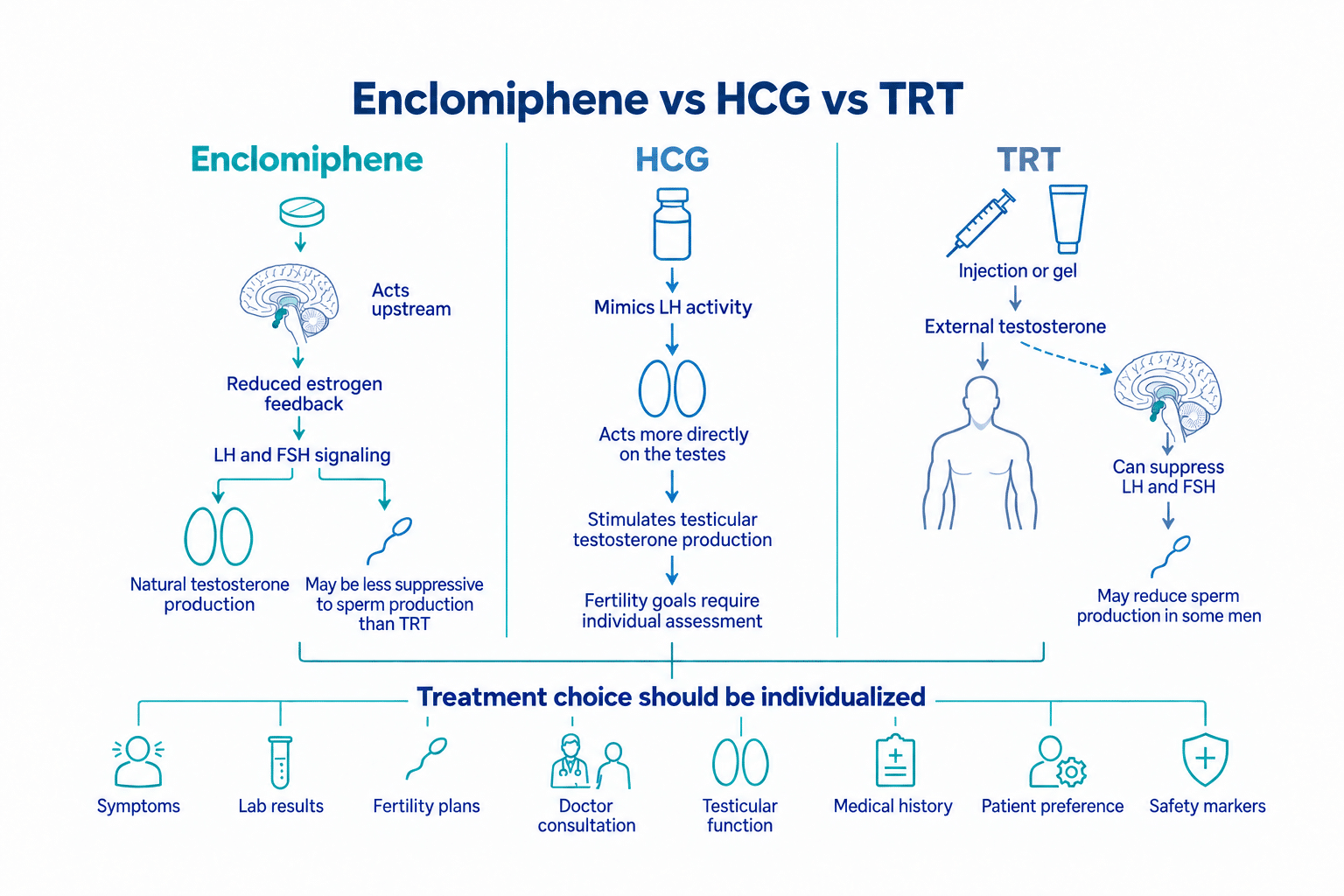
Enclomiphene, HCG, and TRT are different approaches to low testosterone treatment. Enclomiphene stimulates the brain-pituitary-testicular axis by increasing LH and FSH signaling. HCG acts more directly on the testes by mimicking LH activity. TRT provides testosterone directly through injections, gels, or other formulations.
At H.U.M. Clinic, the choice depends on symptoms, lab results, fertility plans, testicular function, medical history, patient preference, and safety markers.
FAQ About Enclomiphene in Thailand
Q: Can I buy enclomiphene in Thailand?
A: Enclomiphene may be available through medical clinics when clinically appropriate. At H.U.M. Clinic, enclomiphene is provided only after physician consultation and blood testing.
Q: How much does enclomiphene cost at H.U.M. Clinic?
A: Enclomiphene 25 mg is available as a 50-tablet box priced at 8,500 THB. Consultation and blood testing are required before treatment.
Q: Is enclomiphene the same as TRT?
A: No. TRT replaces testosterone directly, while enclomiphene aims to stimulate the body’s own testosterone production through LH and FSH signaling.
Q: Can enclomiphene increase testosterone?
A: Yes, enclomiphene may increase testosterone in selected men, especially those with secondary or functional hypogonadism. Response varies and should be confirmed with follow-up blood testing.
Q: Does enclomiphene preserve fertility?
A: Enclomiphene may be less suppressive to sperm production than direct testosterone therapy because it stimulates LH and FSH rather than replacing testosterone. Men actively trying to conceive may still need semen analysis and fertility-focused medical review.
Q: Can I take enclomiphene without blood tests?
A: No. Blood testing is needed to determine whether enclomiphene is appropriate and to monitor testosterone, estradiol, LH, FSH, and safety markers during treatment.

Provides diverse medical services, specializing in male hormone treatment, sexual health, and general practice care. He is dedicated to delivering comprehensive care for international patients, addressing physical, emotional, and mental health needs.