

Key Takeaways
- In healthy couples, one study found small to moderate effects on orgasm intensity and contentment, without changes in sexual drive or arousal. Another study found more positive communication relative to negative communication during couple conflict.
- Because oxytocin’s effects depend on context, H.U.M. Clinic approaches the spray primarily as an intimacy and connection-focused option, not a conventional erectile dysfunction or libido treatment.
- In short-term controlled research, intranasal oxytocin did not show a clear increase in adverse effects compared with placebo. Evidence for frequent or long-term use is limited. Oxytocin nasal spray should not be used during pregnancy.
- Using oxytocin nasal spray for intimacy remains off-label or investigational, and suitability, dose, frequency and duration are decided after medical evaluation.
Table of Contents
Oxytocin is a naturally occurring peptide hormone involved in childbirth, lactation, social bonding, attachment, trust, and aspects of intimate partner interaction.
Because oxytocin is released during physical touch, affectionate interaction, sexual activity, and orgasm, researchers have studied whether intranasal oxytocin may influence emotional closeness, partner connection, intimacy, and post-intimacy experience.
At H.U.M. Clinic, oxytocin nasal spray may be considered for selected patients interested in supporting intimacy and relationship-focused sexual wellness, as part of our peptide therapy service, after doctor consultation and medical review.
How Oxytocin Nasal Spray May Influence Intimacy
Oxytocin binds to receptors in the brain and throughout the body. These pathways are involved in social recognition, emotional processing, attachment, reproductive physiology, and partner-related behavior.
Intranasal administration has been studied as a way of influencing oxytocin-related pathways without injection.
Oxytocin is commonly called the “love hormone,” but this description is too simple. Research suggests that its effects are highly dependent on context.
Rather than simply increasing desire, oxytocin may influence how people process:
- Physical closeness
- Partner interaction
- Affection and touch
- Emotional communication
- Orgasmic experience
- Post-intimacy contentment
- Social and relationship cues
For this reason, H.U.M. Clinic approaches oxytocin nasal spray primarily as an intimacy and connection-focused option, rather than as a conventional erectile dysfunction or libido treatment. This use remains off-label or investigational, and the human studies so far are small and mostly short-term.
What Do Clinical Studies Show?
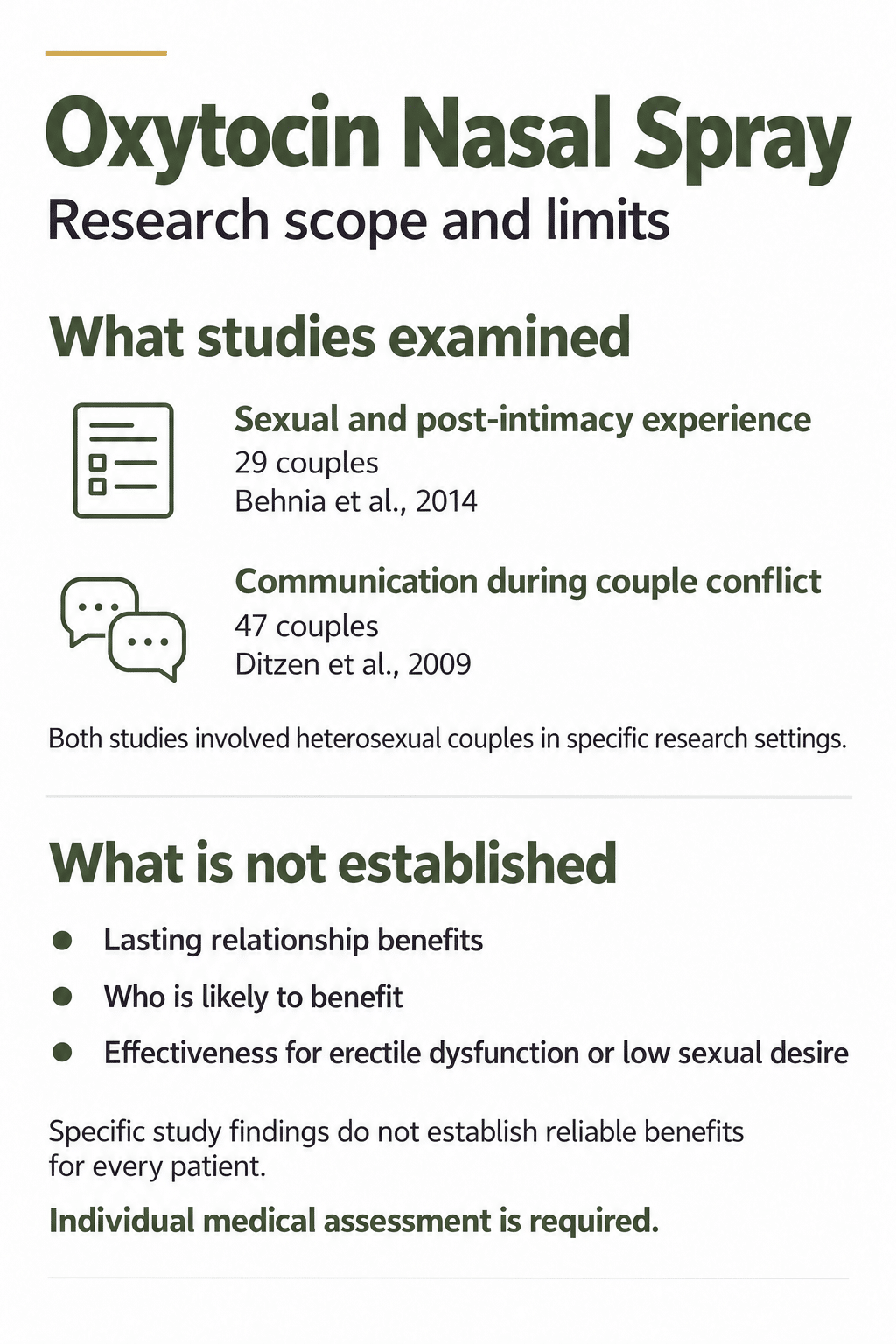
Behnia and colleagues conducted a double-blind, placebo-controlled study involving 29 heterosexual couples.
Participants received 24 IU intranasal oxytocin or placebo before sexual activity.
Researchers found that oxytocin influenced some aspects of the sexual and post-intimacy experience. Participants reported improvements in measures including orgasm intensity and contentment after sexual intercourse, with some effects appearing more pronounced in men.
Oxytocin did not change sexual drive, arousal, erection or lubrication. The reported effects were small to moderate, and the study included only healthy couples.
The more relevant finding for intimacy-focused use is that oxytocin appeared to influence how some participants experienced sexual interaction and the period immediately afterward, rather than simply acting as a performance-enhancing medication.
These findings suggest a possible role in partner experience and emotional context.
In a separate crossover trial, 30 women with sexual dysfunction used oxytocin or placebo before intercourse for 8 weeks each. Sexual function scores improved with both, with no significant difference between the two.
Oxytocin and Partner Connection
One of the most interesting areas of oxytocin research involves communication between couples.
In a randomized, double-blind study involving 47 heterosexual couples, Ditzen and colleagues examined the effects of intranasal oxytocin during a structured couple-conflict discussion.
Compared with placebo, oxytocin was associated with more positive communication relative to negative communication between partners.
Participants receiving oxytocin also demonstrated lower post-conflict cortisol levels.
These results suggest that oxytocin may influence both emotional communication and physiological stress responses during partner interaction.
Oxytocin Nasal Spray Price at H.U.M. Clinic
Current product option:
- Oxytocin nasal spray, 20 IU/spray, 60 sprays: THB 3,690.
Online Consultation and Delivery in Thailand
Patients interested in oxytocin nasal spray may visit H.U.M. Clinic or arrange an online consultation when appropriate.
The process is:
1. Book a doctor consultation
Patients can book an H.U.M. Clinic consultation here.
2. Discuss intimacy and relationship goals
The doctor reviews the patient’s goals, relationship context, medical history, medications, reproductive history, and hormonal factors when clinically appropriate.
3. Review oxytocin suitability
The physician discusses current evidence, realistic expectations, product formulation, possible benefits, limitations, and safety.
4. Arrange treatment and delivery
Eligible clinic-supplied products may be arranged for local or domestic delivery in Thailand following medical review.
Safety Review Before Oxytocin Nasal Spray
A systematic review of 38 randomized controlled trials involving 1,529 participants found no clear increase in adverse effects compared with placebo when intranasal oxytocin was used in controlled research, primarily at short-term research doses.
However, evidence for frequent or long-term use remains more limited.
Potential adverse effects may include:
- Nasal irritation
- Headache
- Nausea
- Dizziness
- Individual cardiovascular responses
- Low blood sodium (hyponatremia) with prolonged high-dose use and large fluid intake
Oxytocin nasal spray should not be used during pregnancy, because oxytocin can trigger uterine contractions. Tell the doctor if you are pregnant, could be pregnant or are planning a pregnancy. Do not use oxytocin nasal spray if you are allergic to oxytocin or any ingredient in the product.
FAQ About Oxytocin Nasal Spray
Can oxytocin nasal spray improve intimacy?
The evidence is limited and mixed. Human research suggests that oxytocin may influence aspects of partner interaction, orgasmic experience, post-intimacy contentment, and communication. However, individual response varies, and it should not be expected to automatically create emotional closeness.
Can oxytocin improve partner connection?
Some randomized research has found more positive communication relative to negative communication between couples during a laboratory conflict discussion after intranasal oxytocin. The effect appears to depend heavily on the existing relationship and social context.
Is oxytocin a “love hormone”?
Oxytocin is involved in attachment and social behavior, but calling it a “love hormone” oversimplifies its effects. It does not automatically create love, trust, or attraction.
Medical Disclaimer
This article is for general medical information only and does not replace consultation with a licensed physician. Intranasal oxytocin for intimacy and sexual-wellness purposes remains an off-label or investigational approach. Suitability, dose, frequency, and treatment duration should be determined after medical evaluation.
References
Behnia B, Heinrichs M, Bergmann W, et al. Differential effects of intranasal oxytocin on sexual experiences and partner interactions in couples. Hormones and Behavior. 2014;65(3):308-318. doi:10.1016/j.yhbeh.2014.01.009.
Ditzen B, Schaer M, Gabriel B, et al. Intranasal oxytocin increases positive communication and reduces cortisol levels during couple conflict. Biological Psychiatry. 2009;65(9):728-731. doi:10.1016/j.biopsych.2008.10.011.
Muin DA, Wolzt M, Marculescu R, et al. Effect of long-term intranasal oxytocin on sexual dysfunction in premenopausal and postmenopausal women: a randomized trial. Fertility and Sterility. 2015;104(3):715-723.e4. doi:10.1016/j.fertnstert.2015.06.010.
MacDonald E, Dadds MR, Brennan JL, et al. A review of safety, side-effects and subjective reactions to intranasal oxytocin in human research. Psychoneuroendocrinology. 2011;36(8):1114-1126. doi:10.1016/j.psyneuen.2011.02.015.

Provides diverse medical services, specializing in male hormone treatment, sexual health, and general practice care. He is dedicated to delivering comprehensive care for international patients, addressing physical, emotional, and mental health needs.

