
Key Summary
Growth hormone peptides and HGH injections both aim to increase growth hormone activity, but they work differently. HGH injections supply synthetic hormones directly to the bloodstream. Growth hormone peptides signal the pituitary gland to produce its own hormone through natural pathways. Each approach carries different mechanisms, regulatory status, and clinical considerations; anyone interested in hormone optimization should consult a qualified physician before starting treatment.
Table of contents
Are you experiencing a loss of muscle, increased body fat, slower post-exercise recovery, sleep disturbances, and reduced energy levels with age? This could be due to a decline in growth hormones.
According to research listed in PMC’s medical database; 24-hour growth hormone production decreases by an estimated 14% every decade.
For the longest time, aging this way was expected until growth hormone peptides and HGH injections entered the picture.
Both aim to increase growth hormone activity in the body through different mechanisms. This article explores the differences between growth hormone peptides and HGH injections, so you can make better-informed choices about your well-being.
What Are Growth Hormone Peptides?
Growth hormone peptides are short chains of amino acids. Rather than introducing hormones directly into the body, they signal the pituitary gland to release more of its own natural growth hormone, stimulating endogenous production.
Several peptides for growth hormone stimulation have been studied in clinical and preclinical settings. The most commonly referenced are the following:
- CJC-1295: A synthetic compound that mimics the body’s natural growth hormone-releasing signal. Research in the Journal of Clinical Endocrinology and Metabolism found that it produced sustained increases in growth hormone and IGF-1 levels in healthy adults.
- Ipamorelin: A short peptide that triggers growth hormone release by activating ghrelin receptors in the pituitary. It is noted for its selectivity, stimulating growth hormone without affecting other hormones like cortisol.
- Sermorelin: A shorter version of the body’s natural growth hormone-releasing hormone. It works through the same receptor pathway as the hormone your body already makes. It was previously FDA-approved for treating growth hormone insufficiency in children, giving it its strong clinical track record.
- GHRP-2 and GHRP-6: Peptides that trigger the pituitary gland to release growth hormone by activating a hunger-related receptor called the ghrelin receptor. Think of them as sending a “release now” signal directly to the gland. Both have been studied mainly in preclinical models, with little human data compared to CJC-1295 or Ipamorelin.
*Important note: Most of these peptides are not FDA-approved for anti-aging or general wellness use. Use in clinical settings is off-label, and human evidence is still limited. Close medical supervision is advised.
Areas of Research for Growth Hormone Peptides
Researchers are studying growth hormone peptides across several areas, but most evidence is preliminary, and outcomes vary depending on the peptide, dosage, and individual physiology:
- Muscle recovery: Growth hormone helps the body build and repair muscle tissue. Higher levels are linked to increased protein synthesis, which supports lean muscle. Studies on CJC-1295 have looked at its potential influence on muscle tissue, though large-scale human trials are still limited.
- Metabolism and body composition: Growth hormone plays a role in how the body breaks down fat for energy. Research has noted potential effects on visceral fat and body composition, though outcomes vary across individuals and populations.
- Sleep quality: Most natural growth hormone release happens during deep sleep. Studies published in PMC confirm that GHRH (the same signaling pathway many peptides activate) promotes slow-wave sleep in humans. Poor sleep and low growth hormone levels tend to be related; hence, supporting one may benefit the other.
What Are HGH Injections?
Human growth hormone (HGH) is produced naturally by the pituitary gland. It regulates growth, protein synthesis, metabolism, and tissue repair throughout a person’s life. Synthetic HGH, developed through recombinant DNA technology since 1985, closely mirrors the natural 191-amino-acid hormone (the building blocks that make up all proteins in the body).
Medical HGH therapy involves injecting recombinant human growth hormone subcutaneously to raise hormone levels directly.
These are some of its FDA-approved medical uses:
- Growth hormone deficiency in both children and adults
- Turner syndrome and Noonan syndrome, which are both conditions associated with growth impairment
- Prader-Willi syndrome, a genetic disorder involving abnormal body composition and growth
- Short bowel syndrome and HIV-related muscle wasting in adults
- Children born small for gestational age who do not catch up in height
*Note: Outside these approved indications, use of synthetic HGH is not sanctioned by regulatory bodies. Medical supervision is advised for off-label use.
Growth Hormone Peptides vs. HGH Injections
Mechanism
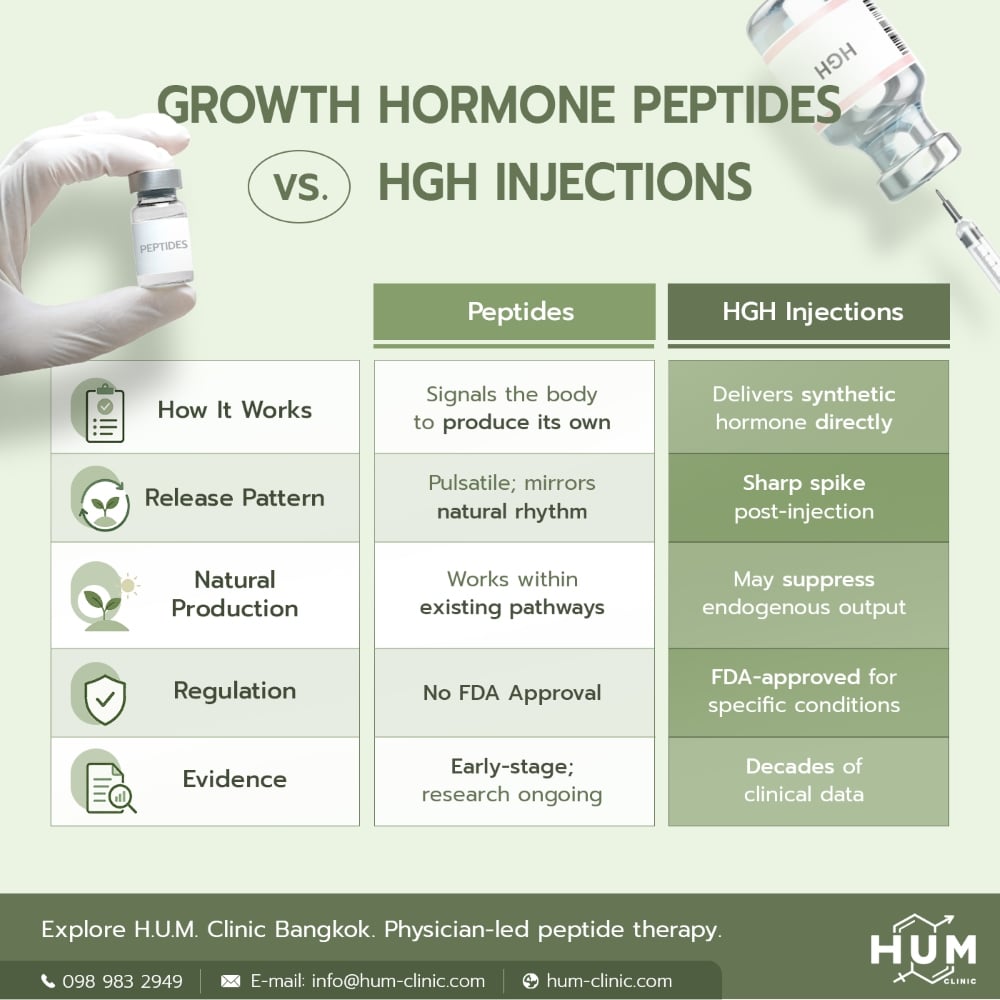
HGH injections introduce synthetic hormones directly into the bloodstream, bypassing the body’s own regulatory system. Growth hormone peptides work upstream, signaling the pituitary gland to release its own hormone through natural secretagogue pathways.
Hormone Release Pattern
Direct HGH injection produces a sharp increase in circulating hormone levels. On the other hand, peptides tend to encourage pulsatile release, closer to the body’s natural rhythm of growth hormone secretion. Ipamorelin, for example, was identified for its ability to stimulate GH release while preserving normal release patterns rather than causing sustained spikes.
Effect on Natural Hormone Production
Introducing external HGH can suppress the body’s own production through negative feedback mechanisms. When circulating hormone levels are already elevated by injection, the pituitary receives signals to reduce its own output. Peptides generally work with existing regulatory pathways rather than overriding them, though this does not eliminate all risk of feedback disruption.
Safety and Regulation
HGH therapy is tightly regulated and prescribed for specific, diagnosed medical conditions. While the benefits of recombinant HGH are well-documented, administration requires careful monitoring due to potential side effects ranging from injection site reactions and carpal tunnel syndrome to more serious metabolic and cardiovascular concerns with long-term use.
Most peptide therapies are not approved treatments, and their clinical use for anti-aging is off-label. Research is evolving, and long-term safety data in healthy adults are limited.
Growth Hormone Peptides vs. HGH Injections: Summary Table
| Factor | Growth Hormone Peptides | HGH Injections |
|---|---|---|
| Mechanism | Stimulates the pituitary to produce natural GH | Supplies synthetic HGH directly to the bloodstream |
| Hormone release pattern | Closer to the body’s natural rhythm | Acute spike following injection |
| Effect on natural production | Generally works within natural regulatory pathways | May suppress endogenous production via feedback |
| FDA approval status | Most do not have FDA approval | Approved for specific medical conditions only |
| Clinical setting | Explored in longevity and regenerative medicine | Prescribed for defined endocrine disorders |
| Evidence base | Preclinical and early human studies. Research ongoing | Decades of clinical data for approved indications |
Peptide Therapy Injections in Longevity Medicine
In clinical settings, a structured protocol for peptide therapy injections for growth hormone support includes:
- Medical evaluation and baseline biomarker testing, including IGF-1 and hormone panels
- Personalized peptide selection based on the patient’s health profile and goals
- Physician-supervised administration, typically subcutaneous injection
- Ongoing monitoring of hormone levels, metabolic markers, and clinical response
- Dosage adjustments based on lab results and patient feedback
These treatments are offered in specialized clinics, always under close medical supervision. Self-administration of unregulated peptides purchased outside official channels carries significant risk and is not endorsed by any major clinical body.
Learn more about peptide therapy injections at H.U.M. Clinic Bangkok.
Get Started at H.U.M. Clinic
Growth hormone peptides and HGH injections both require proper medical evaluation, monitoring, and an individualized protocol.
H.U.M. Clinic Bangkok offers physician-led peptide therapy injections under ISO 9001:2015 quality standards. Our English-speaking doctors assess your baseline hormone levels, design a protocol suited to your health profile, and monitor your response over time. Every service is built around your specific health journey.
To book your peptide therapy consultation, contact us via LINE, WhatsApp, phone at 098 983 2949, or email at [email protected].
References
- Ionescu M, Frohman LA. Pulsatile secretion of growth hormone (GH) persists during continuous stimulation by CJC-1295, a long-acting GH-releasing hormone analog. (2006). Journal of Clinical Endocrinology and Metabolism / PubMed. Retrieved March 2026, from https://pubmed.ncbi.nlm.nih.gov/16352683/
- Raun K, et al. Ipamorelin, the first selective growth hormone secretagogue. (1998). European Journal of Endocrinology / PubMed. Retrieved March 2026, from https://pubmed.ncbi.nlm.nih.gov/9849822/
- Junnila RK, et al. Adult growth hormone deficiency: benefits, side effects, and risks of growth hormone replacement. (2013). Frontiers in Endocrinology / PMC. Retrieved March 2026, from https://pmc.ncbi.nlm.nih.gov/articles/PMC3671347/
- Growth hormone: usage and abuse. (2020). PMC. Retrieved March 2026, from https://pmc.ncbi.nlm.nih.gov/articles/PMC7245490/
- Ayyar VS. History of growth hormone therapy. (2011). Indian Journal of Endocrinology and Metabolism / PMC. Retrieved March 2026, from https://pmc.ncbi.nlm.nih.gov/articles/PMC3183530/
- DiVall SA, Radovick S. Growth hormone and treatment controversy: long-term safety of rGH. (2013). Current Pediatric Reports / PMC. Retrieved March 2026, from https://pmc.ncbi.nlm.nih.gov/articles/PMC3678547/
- Human growth hormone (HGH): what it is, benefits and side effects. (2025, December 22). Cleveland Clinic. Retrieved March 2026, from https://my.clevelandclinic.org/health/articles/23309-human-growth-hormone-hgh
- Adverse events with usage of human growth hormone: a review. (2025, December 6). Discover Medicine / Springer Nature. Retrieved March 2026, from https://link.springer.com/article/10.1007/s44337-025-00474-8
- Reed ML, Merriam GR, Kargi AY. Adult growth hormone deficiency: benefits, side effects, and risks of growth hormone replacement. (2013). Frontiers in Endocrinology / PMC. Retrieved March 2026, from https://pmc.ncbi.nlm.nih.gov/articles/PMC3671347/
Frequently Asked Questions About Growth Hormone Peptides
1) What are growth hormone peptides?
Growth hormone peptides are short chains of amino acids that signal the pituitary gland to release more of the body’s own natural growth hormone. Unlike HGH injections, they do not introduce synthetic hormones directly. Examples include CJC-1295, Ipamorelin, Sermorelin, and GHRP-2. Most are not FDA-approved for anti-aging or wellness use; their application in longevity medicine is off-label and should only be pursued under physician supervision.
2) What is the difference between growth hormone peptides and HGH injections?
HGH injections supply synthetic growth hormone directly to the bloodstream, bypassing the body’s own production system. Growth hormone peptides stimulate the pituitary gland to produce its own hormone through natural signaling pathways. HGH injections may suppress the body’s endogenous production via negative feedback; peptides generally work within existing regulatory systems.
3) Are growth hormone peptides safe?
Research on growth hormone peptides is still evolving. Most clinical data comes from animal models or small human studies, with limited long-term safety data in healthy populations. Side effects vary by peptide and dosage. They are not approved by the FDA for general wellness or anti-aging use. Anyone considering peptide therapy should undergo a full medical evaluation and be monitored by a qualified physician throughout treatment.
4) What does peptide therapy involve at a clinic?
At a specialized clinic, peptide therapy injections typically begin with a medical evaluation and baseline hormone testing, including IGF-1 levels. A physician then selects a peptide protocol suited to the patient’s health profile. Administration is usually subcutaneous. Dosage adjustments are guided by continuous tracking of hormone levels and clinical response. Treatment is always supervised; self-administration of unregulated peptides purchased outside medical channels is not recommended.

Provides diverse medical services, specializing in male hormone treatment, sexual health, and general practice care. He is dedicated to delivering comprehensive care for international patients, addressing physical, emotional, and mental health needs.