
Key Takeaways
- MOTS-c is a mitochondria-derived peptide studied for its potential role in metabolism, insulin sensitivity, and energy regulation, though almost all of this evidence comes from animal and cellular research rather than completed human trials.
- There is currently no established human dosing protocol for MOTS-c and no regulatory approval for any medical use.
- Whether any peptide injection therapy in Bangkok is appropriate depends on an individual's goals, medical history, and lab results.
- H.U.M. Clinic begins every peptide protocol with a private consultation and comprehensive testing.

MOTS-c is a 16-amino-acid peptide encoded directly within mitochondrial DNA, first identified by researchers at the University of Southern California in 2015. The original study found that MOTS-c treatment prevented diet-induced obesity and insulin resistance in mice, a discovery that opened an entirely new area of mitochondrial research.
Much of the interest in MOTS-c comes from laboratory and animal research rather than established clinical treatment protocols. A Phase 2a human trial evaluating MOTS-c for insulin sensitivity in adults with prediabetes and obesity began recruiting in 2026, but no completed human efficacy trials have been published to date.
What Is MOTS-c?
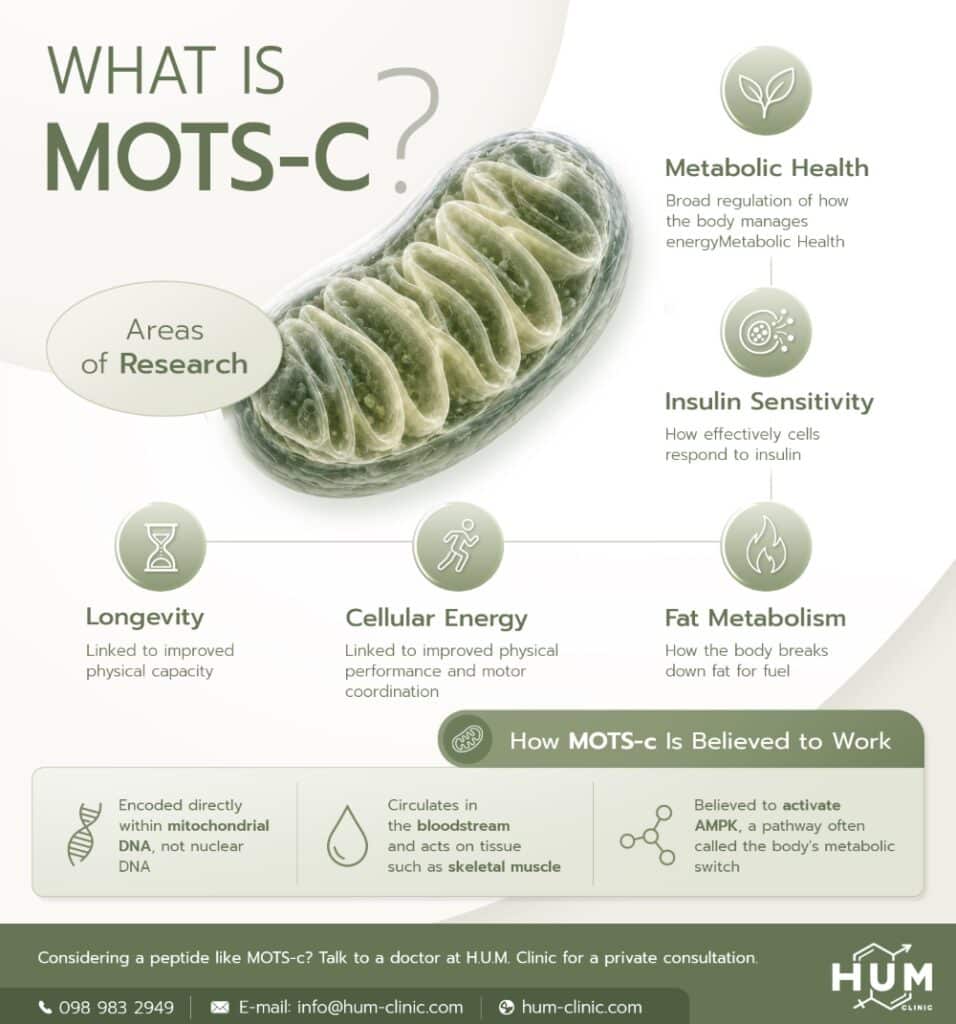
MOTS-c stands for “mitochondrial open-reading-frame of the twelve S rRNA type-c”. Unlike most peptides studied in medicine, which are encoded by nuclear DNA, MOTS-c is encoded within the mitochondria themselves, the structures inside cells responsible for producing energy. Once released, it circulates in the bloodstream and appears to act on metabolic tissue throughout the body, including skeletal muscle.
Researchers believe MOTS-c works partly through the AMPK pathway, a cellular signaling system often described as the body’s metabolic switch, since activating it increases glucose uptake and fat use for energy. This proposed mechanism is why MOTS-c is sometimes described as an exercise mimetic.
MOTS-c is being researched for potential effects in several areas of health:
- Metabolic health
- Insulin sensitivity
- Fat metabolism
- Cellular energy production
- Exercise-related metabolism
- Age-related metabolic changes
MOTS-c Peptide Benefits: What Research Says
MOTS-c has several purported benefits detailed below:
Metabolic Health and Insulin Sensitivity
In preclinical models, MOTS-c treatment prevented diet-induced obesity and insulin resistance in mice fed a high-fat diet. When researchers administered MOTS-c to older mice for seven days, the treatment restored insulin sensitivity in muscle tissue to levels comparable to younger animals, reversing an age-related decline.
Fat Metabolism and Body Composition
A separate study using metabolomics analysis found that MOTS-c increased beta-oxidation, the process cells use to break down fatty acids for energy, in mice fed a high-fat diet. The same research linked MOTS-c treatment to reduced markers of fat accumulation in the liver and lower overall body weight in the treated animals. This offers one possible mechanism behind MOTS-c’s effects on body composition.
MOTS-c and Cellular Energy
Daily MOTS-c treatment was linked to improved physical performance and motor coordination in mice, measured through treadmill and rotarod testing. This is part of why MOTS-c is sometimes described as an exercise mimetic, a compound that reproduces some of the metabolic effects associated with physical activity. Whether this translates into a measurable exercise benefit in humans has not been established.
Healthy Aging and Metabolic Resilience
MOTS-c treatment was linked to improved physical capacity in young, middle-aged, and old mice. Researchers tested mice at roughly 2, 12, and 22 months old, using a rotarod test to measure motor coordination and a treadmill test to measure endurance, and found that MOTS-c improved performance across all three age groups.
Circulating MOTS-c levels also decline with age in mice, a pattern researchers have connected to age-related loss of metabolic and physical function. This is part of why the peptide is being studied for a possible role in metabolic resilience during aging
How Strong Is the Evidence for MOTS-c?
Human research thus far consists of observational biomarker studies, which measured how circulating MOTS-c changes with exercise, age, or metabolic disease. There have not been controlled trials testing MOTS-c as a treatment.
A Phase 2a randomized, placebo-controlled human trial evaluating MOTS-c for insulin sensitivity in adults with prediabetes and obesity began recruiting participants in 2026, which marks a meaningful step toward human evidence, though results are not yet available.
Several questions remain unanswered:
- Optimal dose for human use
- Frequency and treatment duration
- Long-term safety with repeated use
- Clinical effectiveness compared with placebo
- How responses vary between individuals
MOTS-c Dosage: Is There a Standard Dose?
No. There is no dose of MOTS-c that has been validated through completed human clinical trials. Dosing depends on the route of administration, the treatment objective, and individual patient factors such as body weight, metabolic health, and other medications.
Reported Side Effects of MOTS-c
Since MOTS-c has not completed human safety trials, a definitive side-effect profile does not yet exist. However, users and online communities have described a recurring set of side effects.
- Injection site reactions: Pain, redness, swelling, bleeding, or localized irritation at the injection point.
- Systemic symptoms: A faster heart rate, heart palpitations, trouble sleeping, and low-grade fever.
- Mild or anecdotal effects: Fatigue, dizziness, headaches, flushing, and mild digestive upset.
- Metabolic interactions: Possible blood sugar fluctuations or interactions with other medications that also act on the AMPK pathway.
Why You Should Discuss MOTS-c With a Doctor
Because MOTS-c has not completed human clinical trials, a consultation is a reasonable step for anyone considering it, not only for those in a higher-risk group. However, medical evaluation matters most for:
- Anyone with an existing medical condition
- Anyone taking medications that affect glucose metabolism
Self-administering an unregulated peptide outside a medical setting carries its own risks, separate from what is or is not known about MOTS-c itself. Risks of self-administering include:
- Impure or mislabeled product
- Improper reconstitution or injection technique
- No clinician present to catch a contraindication, drug interaction, or adverse reaction early
Clinical monitoring in a medical setting typically includes blood testing and ongoing assessment of response. This is the standard H.U.M. Clinic applies when tailoring any peptide therapy.
MOTS-c vs SS-31: What Is the Difference?
MOTS-c and SS-31 are both mitochondria-related peptides, but they differ in research focus and regulatory status.
| Factor | MOTS-c | SS-31 / Elamipretide |
|---|---|---|
| Origin / type | Naturally occurring, mitochondria-derived peptide | Synthetic, mitochondria-targeted peptide |
| Primary research interest | Metabolic regulation, insulin sensitivity | Mitochondrial membrane stabilization |
| Human clinical trials | None completed for treatment; a Phase 2a trial began recruiting in 2026 | Multiple completed Phase 2/3 trials |
| Regulatory status | Not approved for human use | FDA-approved and under accelerated approval. |
| Established dosage | Not established | 40 mg once daily by subcutaneous injection, specifically for the approved Barth syndrome indication |
Table: MOTS-c vs SS-31.
*SS-31’s approval is limited to Barth syndrome and does not extend to general wellness, longevity, or metabolic use. Neither peptide is objectively “better”; they are studied for different purposes and stand at different points in the regulatory process.
What to Consider Before Trying MOTS-c
- Understand what the research actually shows: MOTS-c’s benefits are largely demonstrated in animal and cellular models, not in completed human trials.
- Avoid self-dosing based on online charts: Numbers presented as standard doses online are not validated by clinical evidence.
- Consider your overall metabolic health: A doctor can assess whether any intervention, peptide or otherwise, is relevant to your specific situation.

Getting Individualized Guidance at H.U.M. Clinic
MOTS-c represents genuinely interesting mitochondrial biology, but it is still lacking human clinical trials. This is where personal consultation becomes crucial. Treating online charts as medical guidance skips the evaluation step that actually determines whether a peptide is appropriate for you.
H.U.M. Clinic’s doctors bring more than 8 years of combined experience providing service to international patients in health matters involving men’s hormones, sexual health, weight management, and more.
Every protocol begins with consultation and blood testing. Here’s how H.U.M. Clinic approaches peptide therapy:
- Personalized peptide therapy based on individual goals
- Medical consultation before treatment begins
- Blood testing to guide protocol decisions
- Medical supervision throughout treatment
- Pharmaceutical-grade peptide sourcing
- Ongoing monitoring and adjustment of treatment protocols
To discuss whether peptide injection therapy in Bangkok may be appropriate for your goals, visit our clinic located a short walk away from BTS Asok and MRT Sukhumvit for a private consultation. Contact H.U.M. Clinic via LINE, WhatsApp, phone at 098 983 2949, or email us at [email protected].
References
- The Mitochondrial-derived Peptide MOTS-c Promotes Metabolic Homeostasis and Reduces Obesity and Insulin Resistance. Retrieved July 20, 2026, from https://pmc.ncbi.nlm.nih.gov/articles/PMC4350682/
- MOTS-c Is an Exercise-Induced Mitochondrial-Encoded Regulator of Age-Dependent Physical Decline and Muscle Homeostasis. Retrieved July 20, 2026, from https://www.nature.com/articles/s41467-020-20790-0
- MOTS-c for Improving Insulin Sensitivity in Adults With Prediabetes and Overweight/Obesity. Retrieved July 20, 2026, from https://clinicaltrials.gov/study/NCT07505745
- The Effect of Chronic Endurance Exercise on Serum Levels of MOTS-c and Humanin in Professional Athletes. Retrieved July 20, 2026, from https://pmc.ncbi.nlm.nih.gov/articles/PMC11273660/
- Mitochondria-Derived Peptides in Aging and Healthspan. Retrieved July 20, 2026, from https://pmc.ncbi.nlm.nih.gov/articles/PMC9057581/
- Mitochondrial-Encoded Peptide MOTS-c Prevents Pancreatic Islet Cell Senescence to Delay Diabetes. Retrieved July 20, 2026, from https://pmc.ncbi.nlm.nih.gov/articles/PMC12411631/
- FDA Approval Letter for Forzinity, Elamipretide HCl, NDA 215244. Retrieved July 20, 2026, from https://www.accessdata.fda.gov/drugsatfda_docs/appletter/2025/215244Orig1s000ltr.pdf
- Highlights of Prescribing Information for FORZINITY, Elamipretide. Retrieved July 20, 2026, from https://www.accessdata.fda.gov/drugsatfda_docs/label/2025/215244s000lbl.pdf
- Stealth BioTherapeutics Announces FDA Accelerated Approval of FORZINITY, Elamipretide HCl, the First Therapy for Progressive and Life-Limiting Ultra-Rare Genetic Disease Barth Syndrome. Retrieved July 20, 2026, from https://www.prnewswire.com/news-releases/stealth-biotherapeutics-announces-fda-accelerated-approval-of-forzinity-elamipretide-hcl-the-first-therapy-for-progressive-and-life-limiting-ultra-rare-genetic-disease-barth-syndrome-302562058.html
Frequently Asked Questions About MOTS-c (FAQs)
Q: What are the potential MOTS-c peptide benefits?
A: Research suggests MOTS-c may play a role in metabolic health, insulin sensitivity, fat metabolism, and cellular energy regulation.
Q: What does MOTS-c peptide do for energy?
A: MOTS-c is produced inside mitochondria, the cell’s energy-producing structures, and appears to activate the AMPK pathway, a signaling system involved in glucose uptake and fat use for energy. This is why it is sometimes described as an exercise mimetic, though the mechanism is still being studied.
Q: What is the recommended MOTS-c dosage?
A: There is no established human dosing protocol for MOTS-c, since no completed human clinical trials have validated a specific dose. Any dosing decision should be made by a doctor based on individual assessment.
Q: Is there a MOTS-c dosage chart or calculator?
A: Dosage charts and calculators are typically based on anecdotal reports rather than clinical trial data. A doctor determines an appropriate approach based on your health history and lab results instead.
Q: What are the side effects of MOTS-c?
A: Reported side effects may include pain, redness, swelling, bleeding, or localized irritation at the injection point, heart palpitations, trouble sleeping, low-grade fever, fatigue, dizziness, headaches, flushing, mild digestive upset, possible blood sugar fluctuations, and possible interactions with other medications that also act on the AMPK pathway.
Q: SS-31 vs MOTS-c: What is the difference?
A: MOTS-c is a naturally occurring peptide studied mainly for metabolic regulation. SS-31, also known as elamipretide, is a synthetic peptide that received FDA accelerated approval in September 2025 for Barth syndrome, an ultra-rare genetic disease.
Q: Is MOTS-c approved for medical use?
A: No. MOTS-c has not been approved by the FDA or any other regulatory body for any human use, and it is not a legally marketed prescription medication. It remains an investigational research compound.
Q: What are MOTS-c peptide benefits according to research?
A: Preclinical research has linked MOTS-c to several proposed benefits, including preventing diet-induced obesity and insulin resistance in mice, increasing fat-burning activity, and improving physical performance and coordination through AMPK activation. Circulating MOTS-c levels also decline with age in mice, which is part of why researchers are studying its role in metabolic resilience.

Wichakorn Jitpraphun, M.D. (Dr. Kamin) is the Co-founder and Medical Director of H.U.M. Clinic, Bangkok. A physician licensed by the Medical Council of Thailand (License No. 51754), he has over 10 years of clinical experience, practicing since 2016. Dr. Kamin holds Certificate Diplomas in Sexual Medicine and Sexology from Thammasat University and Andrology certification from the Society of Men’s Health Singapore. His clinical practice focuses on testosterone replacement therapy (TRT), Men’s health, sexual medicine, HIV prevention and treatment, peptide therapy, and evidence-based medical weight management.