
Key Takeaways
- HCG (human chorionic gonadotropin) is not testosterone. It mimics luteinizing hormone (LH) and may stimulate the testes to produce testosterone when testicular function is still present.
- In selected men on testosterone replacement therapy (TRT), HCG may be used, generally off-label, to help maintain testicular function, testicular size, or fertility potential.
- HCG for post cycle therapy (PCT) is considered only in selected, medically supervised cases. H.U.M. Clinic does not recommend unsupervised steroid use or self-directed PCT.
- A physician consultation and blood testing are required before treatment. Response varies, so follow-up testing helps avoid excessive testosterone or estradiol levels.
- HCG, enclomiphene, and TRT are not interchangeable. The right approach depends on your hormone pattern, fertility goals, and safety profile.
Table of Contents
Many men searching for HCG injection in Bangkok or looking to buy HCG in Thailand are trying to support testosterone production, preserve fertility during TRT, or recover their hormone system after anabolic steroid use. HCG can be useful in selected patients, but it should not be started without medical evaluation and blood testing.
HCG, or human chorionic gonadotropin, acts similarly to luteinizing hormone, or LH. In men, it can stimulate the testes to produce testosterone and may help support testicular function and sperm production in appropriate cases.
At H.U.M. Clinic, HCG injection is available as a 5,000 IU vial. The price is 1,690 THB per vial. A physician consultation and blood testing are required before treatment to confirm whether HCG, TRT, enclomiphene, HMG, rFSH, or another approach is appropriate.
H.U.M. Clinic provides doctor-supervised TRT evaluation, fertility-preserving treatment planning, and follow-up blood testing in Bangkok.
What Is HCG?
HCG stands for human chorionic gonadotropin. Although it is commonly known as a pregnancy-related hormone, HCG is also used medically in selected men because it can activate the LH receptor in the testes.
In men, LH normally signals Leydig cells in the testes to produce testosterone. HCG can mimic this LH-like effect, which may help stimulate natural testosterone production when testicular function is still present.
This makes HCG different from direct testosterone replacement therapy. TRT provides testosterone from outside the body, while HCG aims to stimulate the testes to produce testosterone internally.
HCG may be considered in selected men with low testosterone, secondary hypogonadism, fertility concerns, testicular shrinkage during TRT, or hormone suppression after anabolic steroid exposure. The LH-like action of HCG is described in clinical prescribing information for chorionic gonadotropin.
HCG for TRT
HCG is sometimes used, generally off-label, alongside testosterone replacement therapy in men who want to maintain testicular function, testicular size, or fertility potential while receiving TRT.
Testosterone therapy can suppress LH and FSH from the brain. When LH and FSH are suppressed, the testes may reduce natural testosterone production and sperm production. HCG may help maintain intratesticular testosterone by providing LH-like stimulation to the testes.
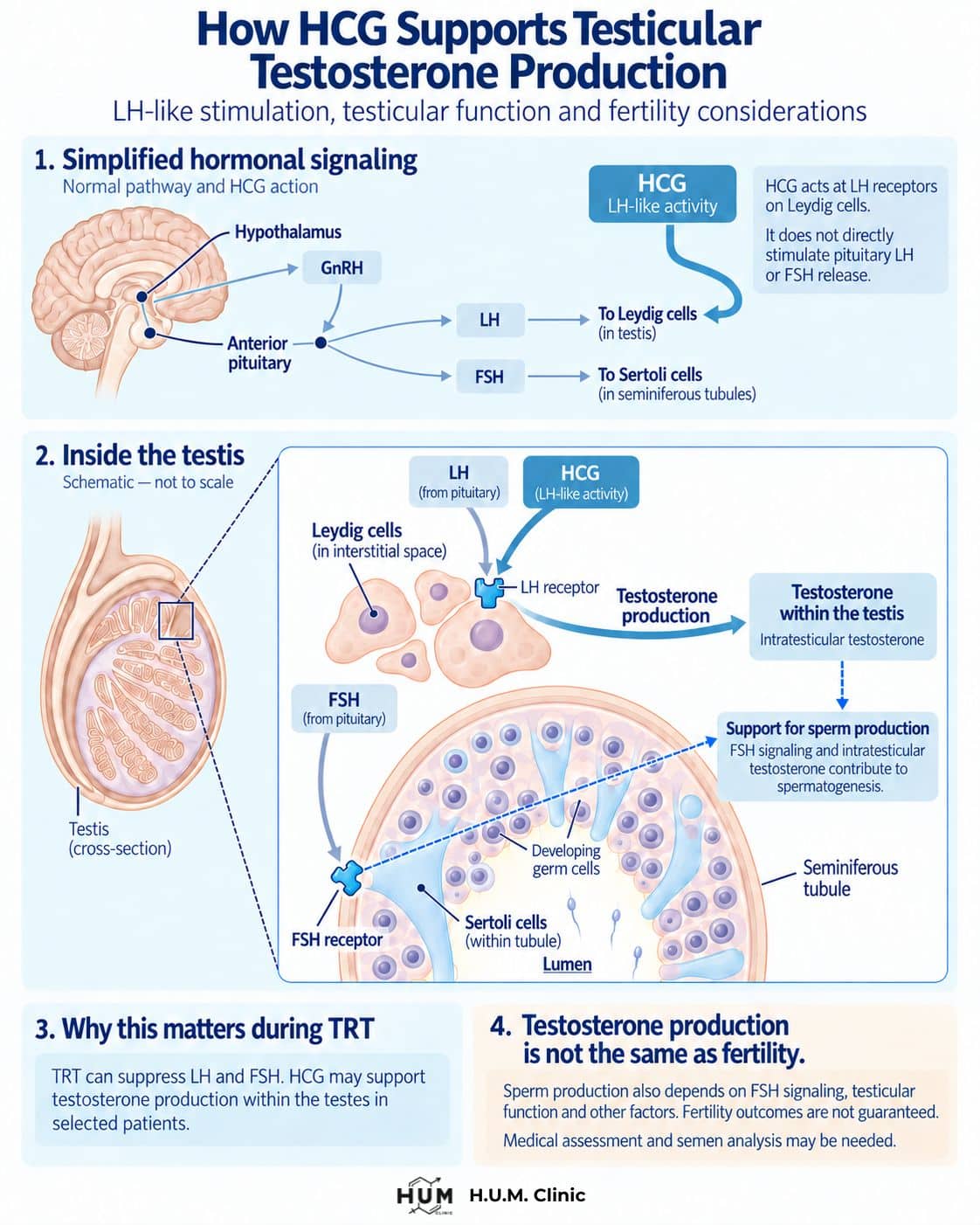
Clinical research has shown that low-dose HCG can help maintain intratesticular testosterone in healthy men whose gonadotropins were suppressed by testosterone injections. Another small retrospective study found that men using testosterone with HCG were able to preserve spermatogenesis during TRT.
At H.U.M. Clinic, HCG for TRT is considered only after reviewing testosterone levels, LH, FSH, estradiol, semen goals, hematocrit, symptoms, current TRT dose, side effects, and fertility plans.
HCG for Post Cycle Therapy (PCT)
Some men search for HCG for post cycle therapy, or HCG for PCT, after using anabolic steroids or non-prescribed hormones. H.U.M. Clinic does not recommend unsupervised steroid use or self-directed PCT, because hormone suppression can vary widely between patients.
After anabolic steroid or testosterone exposure, some men may develop low LH, low FSH, low testosterone, abnormal estradiol, testicular shrinkage, reduced sperm production, libido changes, mood symptoms, acne, high hematocrit, abnormal lipids, or liver-related abnormalities.
Before using HCG for PCT, patients should have blood testing to review testosterone, free testosterone, SHBG, LH, FSH, estradiol, complete blood count, liver function, lipid profile, and semen analysis when fertility is a priority.
For men who are trying to conceive or want to preserve fertility, clinical guidance states that exogenous testosterone therapy should not be prescribed. This is one reason HCG, enclomiphene, HMG, rFSH, or fertility specialist review may be considered in selected patients.
At H.U.M. Clinic, HCG for PCT is considered only after doctor-supervised hormone evaluation, blood testing, and review of fertility goals, previous hormone use, and safety markers.
HCG Price at H.U.M. Clinic
H.U.M. Clinic provides HCG injections for selected patients after physician evaluation.
Current HCG product format:
- HCG injection
- 5,000 IU vial
- Price: 1,690 THB per vial
- Physician consultation required
- Blood testing required before treatment
- Follow-up monitoring recommended based on treatment goal
The total cost of treatment depends on the number of vials required, treatment duration, blood tests, consultation, and whether additional medications such as clomiphene, tamoxifen, HMG, rFSH, or testosterone therapy are needed.
Patients should not choose HCG based on price alone. The most important step is confirming whether HCG matches the patient’s hormone pattern, fertility goal, and safety profile.
Blood Tests Before HCG
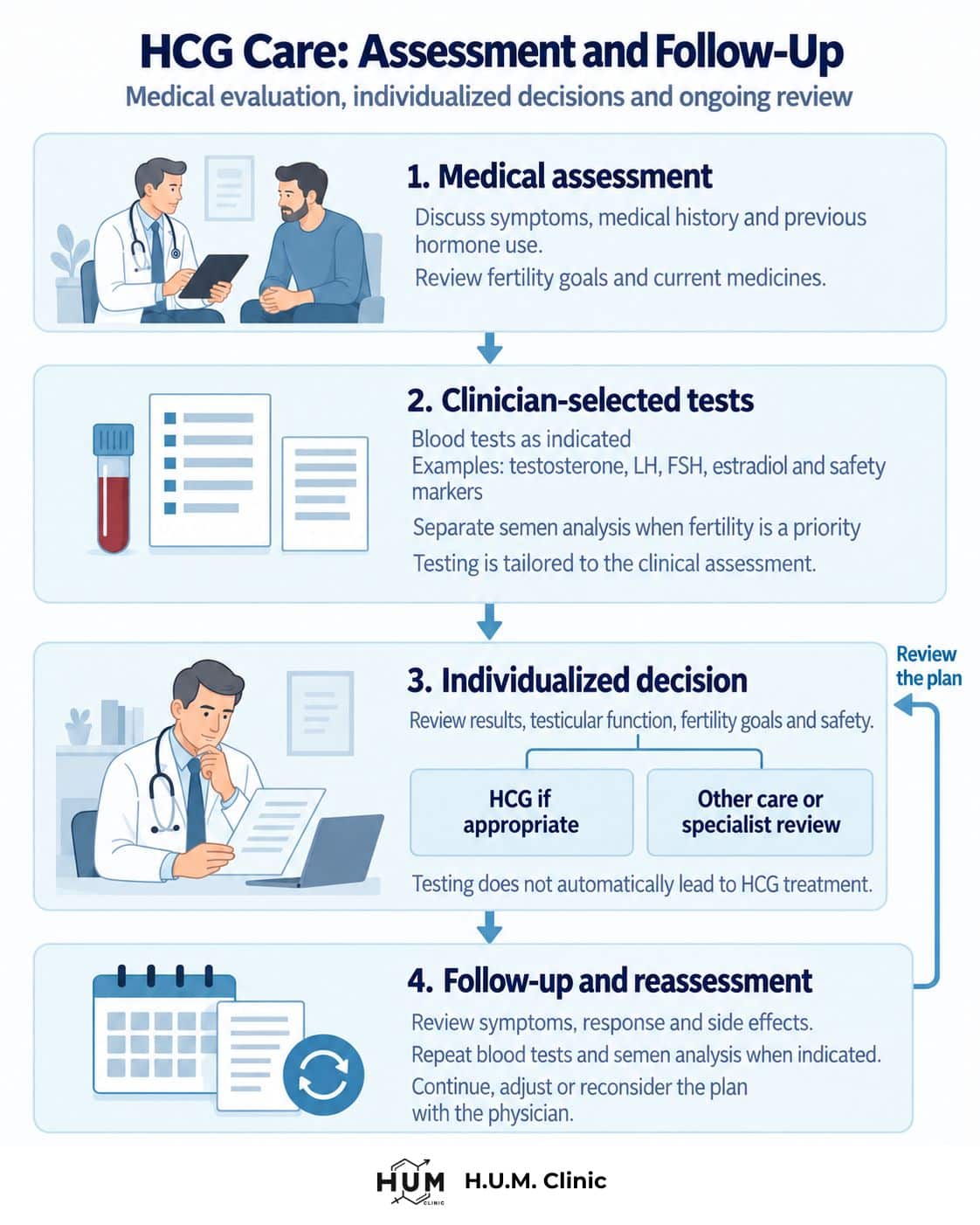
Blood testing is important before starting HCG because symptoms alone cannot determine whether HCG is the correct treatment.
Baseline testing may include total testosterone, free testosterone or calculated free testosterone, SHBG, LH, FSH, estradiol, complete blood count with hematocrit, liver and kidney function, fasting glucose or HbA1c, lipid profile, prolactin when clinically indicated, PSA when appropriate, and semen analysis when fertility is a priority.
These tests help determine whether low testosterone is primary, secondary, functional, medication-related, obesity-related, sleep-related, anabolic-steroid-related, or related to another endocrine condition.
HCG is generally more useful when the testes can still respond to LH-like stimulation. If LH and FSH are already high, or if there is primary testicular failure, HCG may be less effective and another medical approach may be needed.
HCG Injection and Monitoring
HCG is usually given as a subcutaneous or intramuscular injection, depending on the product, protocol, and physician recommendation. The dosing schedule should be individualized based on treatment goal, testosterone level, estradiol response, fertility plan, and side effects.
Patients should not self-adjust HCG dose or combine HCG with testosterone, enclomiphene, aromatase inhibitors, anabolic steroids, HMG, or rFSH without medical supervision.
Follow-up monitoring may include symptoms, libido response, total and free testosterone, estradiol, hematocrit, acne, oily skin, mood changes, water retention, testicular size or discomfort, and semen analysis if fertility is the goal.
Because HCG can increase testosterone and estradiol in some men, follow-up testing is important to avoid excessive hormone levels or unnecessary side effects.
HCG vs Enclomiphene vs TRT
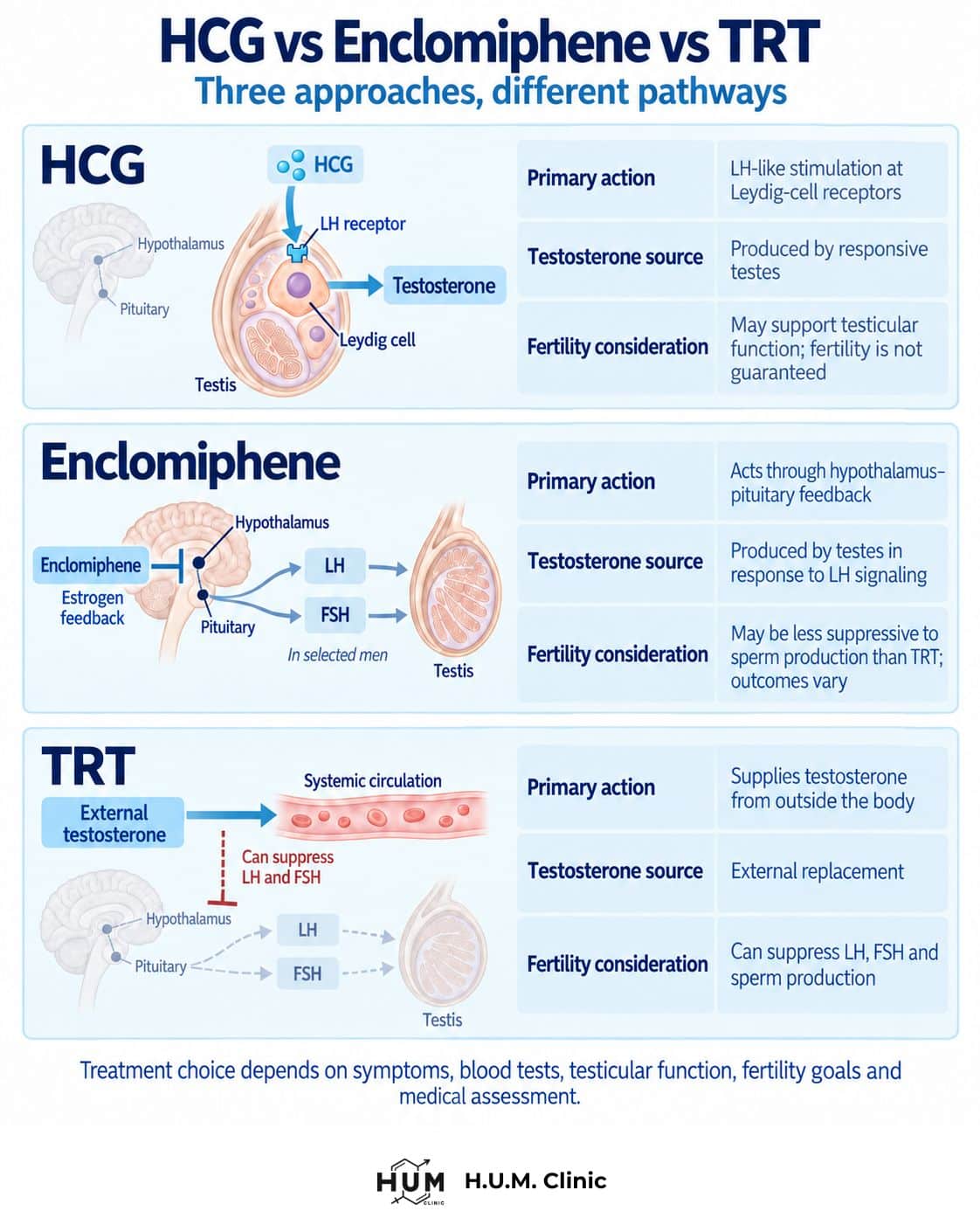
HCG, enclomiphene, and TRT are different approaches to low testosterone and fertility-preserving hormone care.
HCG acts directly on the testes by mimicking LH activity. It may be useful when the goal is to stimulate testicular testosterone production or support fertility-related function.
Enclomiphene works higher up in the hormone axis by stimulating LH and FSH through the hypothalamus and pituitary gland. It may be considered in selected men with secondary or functional hypogonadism.
TRT provides testosterone directly through injections, gels, or other formulations. For men comparing HCG with TRT treatment options in Bangkok, the decision should be based on symptoms, testosterone level, LH, FSH, estradiol, fertility goals, semen analysis when needed, and safety markers. The AUA testosterone deficiency guideline also highlights the importance of diagnosis, counseling, monitoring, and fertility consideration before testosterone therapy.
At H.U.M. Clinic, these options are not interchangeable. The right approach depends on whether the goal is to restore testosterone directly, stimulate natural testosterone production, preserve fertility, or manage hormone suppression after previous steroid or testosterone use.
Doctor-Supervised HCG at H.U.M. Clinic
For patients searching for HCG injection in Bangkok, H.U.M. Clinic provides HCG only as part of a doctor-supervised hormone evaluation and treatment plan.
HCG may be considered for selected men who need fertility-preserving TRT options, testicular function support during testosterone therapy, or medically supervised hormone recovery after anabolic steroid or testosterone use.
Our approach includes consultation with Thai-licensed, English-speaking physicians, review of symptoms and previous hormone use, baseline hormone and safety blood testing, fertility discussion, individualized treatment planning, clear explanation of HCG price, and follow-up blood testing.
HCG may be appropriate for selected men, but it is not a shortcut for unsafe steroid use, bodybuilding enhancement, or unsupervised hormone manipulation. The goal is to use HCG only when it matches the patient’s diagnosis, fertility goals, and safety profile.
FAQ About HCG in Bangkok
Can I buy HCG in Thailand?
HCG may be available through medical clinics or hospitals when clinically appropriate. At H.U.M. Clinic, HCG is provided only after physician consultation and blood testing.
How much is HCG at H.U.M. Clinic?
HCG injection is available as a 5,000 IU vial priced at 1,690 THB. Consultation, blood testing, and follow-up costs may vary depending on the treatment plan.
Is HCG used with TRT?
Yes. HCG may be used with TRT in selected men who want to support testicular function or fertility potential. It should be prescribed and monitored by a physician.
Is HCG used for PCT?
Some men ask about HCG for PCT after anabolic steroid use. HCG may be considered in selected medically supervised cases, but H.U.M. Clinic does not recommend unsupervised steroid use or self-directed PCT.
Does HCG increase testosterone?
HCG can stimulate the testes to produce testosterone in men whose testes can respond to LH-like signaling. Response varies and should be confirmed with blood testing.
Is HCG the same as testosterone?
No. HCG is not testosterone. HCG stimulates the testes to produce testosterone, while TRT provides testosterone directly from outside the body.
Medical Disclaimer
This article is for general medical information only and does not replace consultation with a licensed physician. HCG suitability, dose, injection schedule, treatment duration, monitoring, and fertility planning should be determined after medical evaluation and blood testing.

Wichakorn Jitpraphun, M.D. (Dr. Kamin) is the Co-founder and Medical Director of H.U.M. Clinic, Bangkok. A physician licensed by the Medical Council of Thailand (License No. 51754), he has over 10 years of clinical experience, practicing since 2016. Dr. Kamin holds Certificate Diplomas in Sexual Medicine and Sexology from Thammasat University and Andrology certification from the Society of Men’s Health Singapore. His clinical practice focuses on testosterone replacement therapy (TRT), Men’s health, sexual medicine, HIV prevention and treatment, peptide therapy, and evidence-based medical weight management.