

Key Takeaways
- Sustainable weight loss depends on hormonal balance, sleep, and protein intake as much as it depends on calories and movement.
- Chronic stress, poor sleep, low testosterone, and hypothyroidism can silently stall fat loss even when effort is high.
- GLP-1 and dual GIP/GLP-1 medications are the current clinical standard for medical weight loss, with the SURMOUNT-1 trial showing 22.5% body weight reduction at the highest tirzepatide dose over 72 weeks.
- For adults who have plateaued despite genuine effort, a supervised program at a weight loss treatment clinic in Bangkok can address the underlying drivers with clinical assessment and evidence-based medication.
Most people trying to lose weight are already doing the obvious things, such as cutting back at meals, walking more, or skipping a sugary drink. Yet the scale barely moves. In truth, knowing how to lose weight starts with recognizing that the answer is rarely more willpower. According to the World Health Organization, more than 890 million adults worldwide were living with obesity in 2022, and the global rate has more than doubled since 1990.
The real barriers to fat loss are almost always physiological, where hormones set your hunger, sleep shapes your cravings, and chronic stress changes where your body stores fat. If weight loss is your goal, here’s what to know about what actually drives weight loss, why it stalls in otherwise disciplined people, and when a supervised medical program becomes the appropriate clinical step.
Why Weight Loss Is Harder Than Calories In and Out
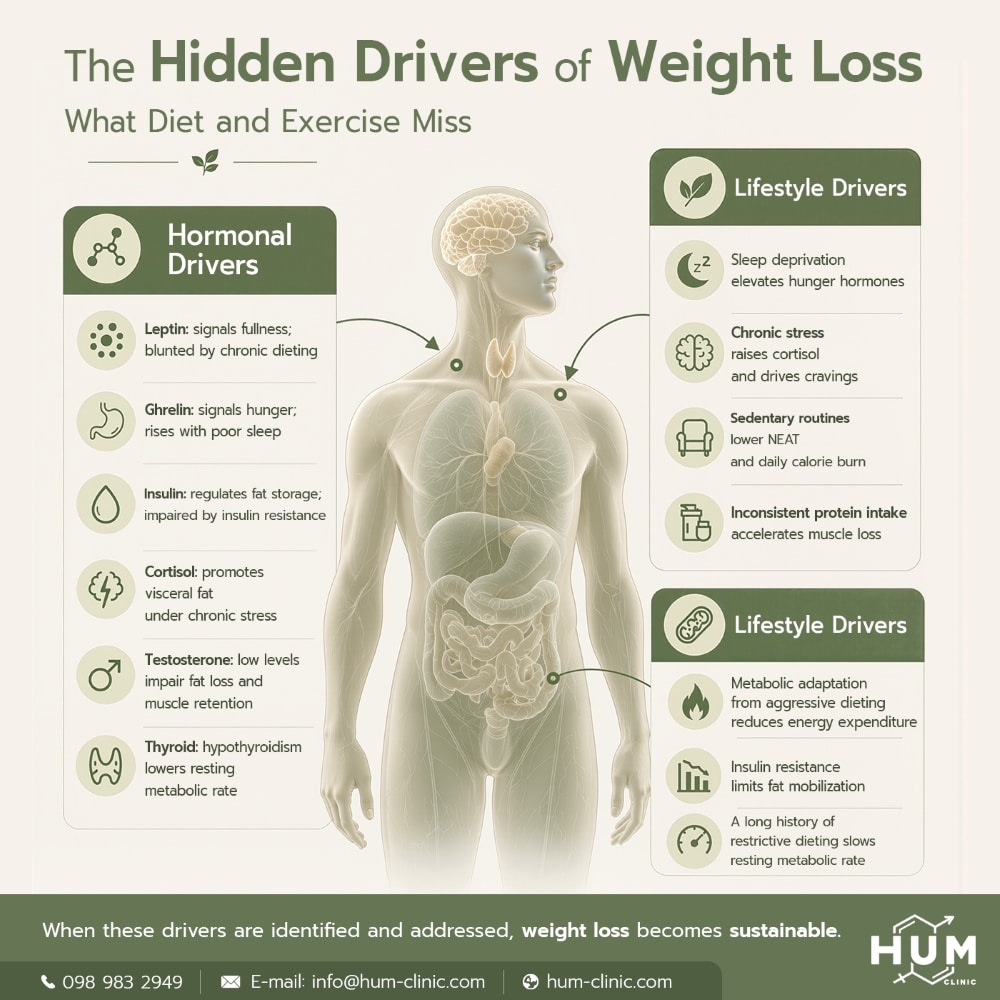
Calories in versus calories out is a real framework, but it is not the whole story. What controls when you feel hungry, how satisfied a meal leaves you, and where fat gets stored is a hormonal system you can’t consciously control.
There are a few body signals: leptin signals fullness, ghrelin signals hunger, and insulin regulates fat storage. When any of these get distorted, managing your calorie intake gets much harder. Other conditions like low testosterone, hypothyroidism, and insulin resistance all also impede fat loss and often go undiagnosed for years.
Moreover, sleep matters more than most people realize. A 2004 PLoS Medicine study of 1,024 adults found that short sleep duration was associated with reduced leptin, elevated ghrelin, and higher body mass index. Another factor is chronic stress, which adds to the burden by raising cortisol, promoting visceral fat accumulation around the abdomen regardless of what you’re eating.
For people who have tried the obvious and plateaued, the barrier is usually physiological, not motivational.
How Many Calories You Need to Lose Weight
A caloric deficit is still the baseline. A daily reduction of roughly 500 to 750 kcal below total daily energy expenditure produces around 0.5 to 1 kg of loss per week for most people. That said, that range depends on age, body composition, activity level, and metabolic health, which means a flat 1,200 kcal target rarely fits any specific individual.
Aggressive undereating triggers metabolic adaptation, where the body becomes more efficient at storing energy in response to restriction. A 2016 Obesity study of contestants from The Biggest Loser found that resting metabolic rate remained approximately 500 kcal per day below expected values six years after the competition ended. In essence, dieting is not futile, but overly aggressive restriction can work against you.
For anyone with a metabolic condition, a hormonal imbalance, or a long history of stalled attempts, calorie targets are better set through clinical consultation than through a phone app.
How Many Steps a Day to Lose Weight
10,000 steps a day is commonly touted, but the figure is a marketing legacy, not a clinical guideline. A 2022 Lancet Public Health meta-analysis of 15 international cohorts found that mortality risk stops improving at:
- 6,000 to 8,000 steps per day for adults aged 60 and older
- 8,000 to 10,000 steps per day for adults under 60
Non-exercise activity thermogenesis, or NEAT, often contributes more to total daily calorie burn than structured workouts, and small movements across the day add up faster than a single gym session. A 2025 systematic review published in The Lancet Public Health confirmed that 7,000 steps per day is associated with clinically meaningful reductions in cardiovascular disease, type 2 diabetes, dementia, and depression risk.
For people with obesity or joint limitations, step targets should be built gradually rather than measured against a blanket number. Movement supports fat loss, but it rarely drives it on its own when the hormonal or metabolic factors are unaddressed.
How Much Protein You Need to Lose Weight
Protein reduces ghrelin, the hunger hormone, and increases peptide YY, a satiety signal. That combination makes it the most practically useful macronutrient for sustaining a caloric deficit without constant hunger.
With that, distributing protein across three or four meals improves muscle protein synthesis compared with consuming most of it at dinner. In Bangkok, practical sources of protein are widely available, including:
- Eggs
- Chicken breast
- Fish, including tuna and salmon
- Tofu and tempeh
- Greek yogurt and cottage cheese
People cutting calories often reduce protein-rich foods first, which accelerates muscle loss and slows metabolism. That makes the deficit harder to sustain and easier to regain from.

Self-directed approaches work for a portion of people, but for others, physiology can create a ceiling that diet and exercise alone cannot overcome. Clinically appropriate candidates for medical treatment include adults with a BMI over 25 who also carry a weight-related condition, adults with a BMI over 30, or anyone with a documented plateau despite sustained lifestyle effort.
GLP-1 receptor agonists and dual GIP/GLP-1 medications are currently the clinical standard for medical weight loss. The SURMOUNT-1 trial published in the New England Journal of Medicine reported average body weight reductions of 21.4% at the 10 mg dose and 22.5% at the 15 mg dose of tirzepatide over 72 weeks, compared with 2.4% for placebo.
However, a medical program is a response to physiology, not a replacement for addressing lifestyle drivers alongside it. Dose, medication choice, and monitoring should be determined by a doctor who has carefully reviewed your metabolic labs, health history, and goals.
Explore Weight Loss Treatment at H.U.M. Clinic
Knowing how to lose weight sustainably means addressing the biological drivers underneath the effort, including hormonal balance, insulin sensitivity, hunger regulation, and protein intake. If you have stalled in your weight loss journey despite genuine work, the barrier is usually physiological, and seeking a clinical response may be your next best course of action.
At H.U.M. Clinic, our doctors bring over 8 years of experience in metabolic health and weight management. Our programs are built around individual assessment, using Thai FDA-approved GLP-1 and GIP/GLP-1 medications sourced from licensed pharmaceutical distributors. Every plan is doctor-supervised with structured follow-ups and lab checks and delivered by English-speaking doctors to provide you the best treatment path.
Book a consultation at our weight loss treatment clinic in Bangkok to have your metabolic profile assessed and a treatment plan built around your goals.
Contact H.U.M. Clinic:
- LINE: https://lin.ee/jsyyxh6
- WhatsApp: https://wa.me/66989832949
- Phone: 098 983 2949
- Email: [email protected]
References:
Obesity and Overweight. Retrieved July 9, 2026, from https://www.who.int/news-room/fact-sheets/detail/obesity-and-overweight
Tirzepatide Once Weekly for the Treatment of Obesity. Retrieved July 9, 2026, from https://www.nejm.org/doi/full/10.1056/NEJMoa2206038
Daily Steps and All-Cause Mortality: A Meta-Analysis of 15 International Cohorts. Retrieved July 9, 2026, from https://pmc.ncbi.nlm.nih.gov/articles/PMC9289978/
Daily Steps and Health Outcomes in Adults: A Systematic Review and Dose-Response Meta-Analysis. Retrieved July 9, 2026, from https://www.thelancet.com/journals/lanpub/article/PIIS2468-2667(25)00164-1/fulltext
Short Sleep Duration Is Associated with Reduced Leptin, Elevated Ghrelin, and Increased Body Mass Index. Retrieved July 9, 2026, from https://journals.plos.org/plosmedicine/article?id=10.1371/journal.pmed.0010062
International Society of Sports Nutrition Position Stand: Protein and Exercise. Retrieved July 9, 2026, from https://jissn.biomedcentral.com/articles/10.1186/s12970-017-0177-8
Persistent Metabolic Adaptation 6 Years After The Biggest Loser Competition. Retrieved July 9, 2026, from https://pmc.ncbi.nlm.nih.gov/articles/PMC4989512/
Weight Loss Treatment in Bangkok. Retrieved July 9, 2026, from https://www.hum-clinic.com/service/weight-loss-treatment/
Frequently Asked Questions About How to Lose Weight
Q: What is the best injection for weight loss in Thailand?
A: The most clinically studied injectable options in Thailand are Thai FDA-approved GLP-1 medications like semaglutide and dual GIP/GLP-1 medications like tirzepatide. Which one is best depends on your BMI, metabolic labs, health history, and treatment goals, which is why medication selection should follow a doctor consultation.
Q: How many calories should I eat to lose weight?
A: A daily deficit of 500 to 750 kcal below your total daily energy expenditure typically produces 0.5 to 1 kg of weekly weight loss. Precise targets depend on age, body composition, activity level, and metabolic health. A clinical consultation is more reliable than a phone app, especially for anyone with a metabolic or hormonal condition.
Q: How many steps a day to lose weight?
A: For general health, 7,000 to 8,000 steps per day is a research-supported target. For fat loss specifically, steps amplify the effects of a caloric deficit rather than driving results on their own. What matters most is consistent daily movement combined with an appropriate deficit and adequate protein.
Q: How much protein do I need to lose weight?
A: 1.4 to 2.0 grams of protein per kilogram of body weight per day supports muscle preservation during weight loss for active adults. A 70 kg person needs roughly 100 to 140 grams daily. Distributing protein across three or four meals improves how your body uses it compared to loading most of it at dinner.
Q: How to lose weight fast on metformin?
A: Metformin is not a fast weight loss drug. It is FDA-approved for type 2 diabetes and produces modest weight loss of roughly 2 to 3 kg over 6 months in most people, with the effect coming from mildly reduced appetite and improved insulin sensitivity. For meaningful or faster results, GLP-1 and dual GIP/GLP-1 medications show substantially larger reductions in clinical trials and should be discussed with a doctor.

Provides diverse medical services, specializing in male hormone treatment, sexual health, and general practice care. He is dedicated to delivering comprehensive care for international patients, addressing physical, emotional, and mental health needs.