
What to Know About Gonorrhea, Its Symptoms & Treatment
Key Takeaways
- Gonorrhea is one of the most common bacterial STIs worldwide, and a significant proportion of infections produce no symptoms at all.
- Symptoms differ between men and women, with discharge being one of the most recognizable indicators in men.
- Gonorrhea is fully curable with the correct antibiotic treatment, but self-treatment is not effective and contributes to antibiotic resistance.
- PCR testing offers the most accurate detection, especially for infections in the throat and rectum.
Table of contents

Gonorrhea is one of the most common bacterial sexually transmitted infections in the world, with roughly 82 million new cases every year, according to the World Health Organization. A large number of infections are asymptomatic. You can carry it, pass it on, and never know unless you get tested.
But despite how widespread it is, gonorrhea is fully curable with the right treatment. We examine what and how gonorrhea symptoms differ between men and women and the relevant treatment.
What Is Gonorrhea?
Gonorrhea is caused by the bacterium Neisseria gonorrhoeae. It infects the mucous membranes of the genitals, rectum, and throat. Transmission happens through unprotected vaginal, anal, or oral sex, and can also pass from mother to child during birth. It’s one of the oldest documented STIs, with references dating back to 2600 BCE.
Colloquially, there is a reason why gonorrhea is called the clap. Two theories have the most historical support: Les Clapiers, a brothel district in medieval Paris, and the Old English word “clappan,” meaning “beating” or “throbbing,” likely describing painful urination. Neither has been proven definitively, but the term has stuck.
Can You Get Gonorrhea from Kissing?
Standard kissing carries an extremely low risk, as saliva doesn’t contain Neisseria gonorrhoeae in meaningful concentrations.
Oral gonorrhea, however, is a different story. It’s transmitted through oral sex, not kissing, and up to 90% of pharyngeal cases produce no symptoms at all. A standard urine test won’t detect a throat infection, and so targeted site-specific testing is required.
Gonorrhea Symptoms in Men
Not all men develop gonorrhea symptoms, but when they do appear, it’s typically 2 to 14 days after exposure. Common signs of gonorrhea include burning or painful urination, yellow or green penile discharge, and testicular pain or swelling. The pus-like and yellowish-green discharge is one of the most recognizable indicators of a gonorrhea infection.
Gonorrhea can also infect other sites and infections around the rectum may cause itching, discharge, or bleeding. Throat infections are typically silent. Rectal and throat infections in men who have sex with men are often only identified through site-specific testing.
If left untreated, gonorrhea can cause epididymitis, urethral scarring, and in rare cases, fertility issues.
Gonorrhea Symptoms in Women
Most women with gonorrhea have no symptoms or symptoms easily confused with a UTI or yeast infection. Gonorrhea symptoms present in female patients may include increased vaginal discharge, burning during urination, bleeding between periods, pain during sex, and lower abdominal pain. As gonorrhea discharge in women can be watery, yellowish, or greenish, it doesn’t always look different from normal vaginal discharge, which is why it’s often overlooked.
If left untreated, gonorrhea in women can lead to pelvic inflammatory disease, chronic pelvic pain, ectopic pregnancy, infertility, and increased susceptibility to HIV. Routine screening matters because waiting for symptoms misses too many cases.
Is Gonorrhea Curable?
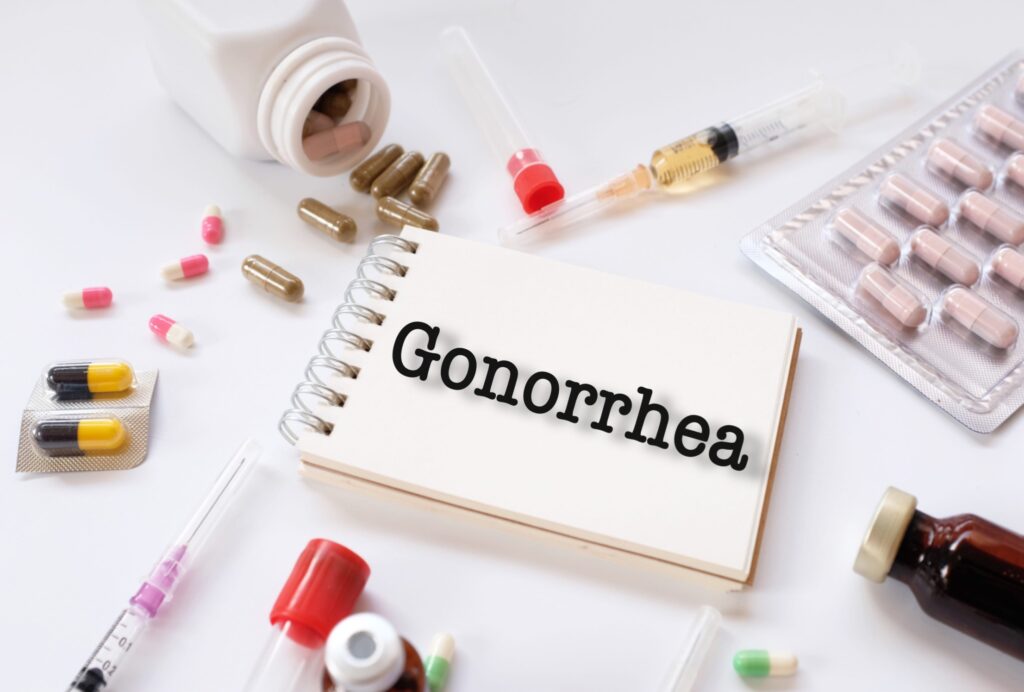
Yes. Antibiotics are used to treat chlamydia and gonorrhea, where the current CDC first-line treatment is a single intramuscular injection of ceftriaxone at 500 mg. If chlamydia co-infection hasn’t been ruled out, doxycycline or azithromycin is added for seven days.
Regarding whether doxycycline can cure gonorrhea and chlamydia, doxycycline treats chlamydia effectively, but is not reliable for gonorrhea on its own. The typical treatment when both conditions are present involves ceftriaxone and doxycycline, administered by a doctor.
In a related development, there is doxy-PEP. In 2024, the CDC recommended that higher-risk groups can take 200 mg of doxycycline within 72 hours of sexual activity to reduce their risk of bacterial STIs. Trials showed reductions of over 70% for syphilis and chlamydia, and roughly 50% for gonorrhea.
Why STD PCR Testing Matters for Gonorrhea
Gonorrhea often infects multiple sites without symptoms, and standard urine or swab cultures can miss infections, especially in the throat or rectum. That’s where STD PCR testing comes in, being able to detect the DNA of Neisseria gonorrhoeae directly while offering higher sensitivity and specificity than culture-based methods.
PCR testing is recommended for anyone who has had unprotected sex, has new or multiple partners, or is asymptomatic but at risk. Site-specific testing at all anatomic sites of exposure is the clinical standard. If you have partners, they should be tested and treated simultaneously as well to prevent reinfection.
Get Tested at H.U.M. Clinic Bangkok
Despite being very common and often silent, gonorrhea is entirely curable. You don’t have to live with the burden of an STD, and the only barrier is getting a timely and accurate test. And for that, we are here to help.
H.U.M. Clinic offers STD PCR testing in Bangkok with same-day results, ISO 15189:2022 and QCMD 2024-accredited laboratory services, and English-speaking doctors in a discreet, private setting. Every test of ours is handled with the accuracy and confidentiality you should expect from a trusted medical facility.
Book a confidential STD PCR test at H.U.M. Clinic Bangkok today. You can contact us via LINE, WhatsApp, phone at 098 983 2949, or email at [email protected]. Our clinic is located near BTS Asok and MRT Sukhumvit.
References
- Epidemiology of Gonorrhea: A Global Perspective. Retrieved 1 April 2026, from https://pmc.ncbi.nlm.nih.gov/articles/PMC7064409/
- Clinical Treatment of Gonorrhea. Retrieved 1 April 2026, from https://www.cdc.gov/gonorrhea/hcp/clinical-care/index.html
- The Management of Gonorrhea in the Era of Emerging Antimicrobial Resistance. Retrieved 1 April 2026, from https://pmc.ncbi.nlm.nih.gov/articles/PMC11150008/
- Drug-Resistant Gonorrhea. Retrieved 1 April 2026, from https://www.cdc.gov/gonorrhea/hcp/drug-resistant/index.html
- CDC Clinical Guidelines on the Use of Doxycycline Postexposure Prophylaxis for Bacterial STI Prevention, United States, 2024. Retrieved April 2026, from https://www.cdc.gov/mmwr/volumes/73/rr/rr7302a1.htm
- WHO warns of rising, worrisome levels of drug-resistant gonorrhea. Retrieved 1 April 2026, from https://www.cidrap.umn.edu/gonorrhea/who-warns-rising-worrisome-levels-drug-resistant-gonorrhea
- Gonococcal Infections Among Adolescents and Adults: STI Treatment Guidelines. Retrieved 1 April 2026, from https://www.cdc.gov/std/treatment-guidelines/gonorrhea-adults.htm
- Gonorrhoea: A Systematic Review of Prevalence Reporting Globally. Retrieved 1 April 2026, from https://pmc.ncbi.nlm.nih.gov/articles/PMC8582208/
- Update to CDC’s Treatment Guidelines for Gonococcal Infection, 2020. Retrieved 1 April 2026, from https://www.cdc.gov/mmwr/volumes/69/wr/mm6950a6.htm
- Doxycycline Post-Exposure Prophylaxis to Prevent Bacterial Sexually Transmitted Infections. Retrieved 1 April 2026, from https://www.ncbi.nlm.nih.gov/books/NBK597440/
Frequently Asked Questions About Gonorrhea
Q1: Is gonorrhea curable with antibiotics?
Yes. The CDC-recommended treatment is a single injection of ceftriaxone at 500 mg. Doxycycline is added if chlamydia hasn’t been ruled out. Over-the-counter medication does not work against gonorrhea.
Q2: What does gonorrhea discharge look like in men and women?
In men, it’s typically thick, pus-like, and yellowish-green. In women, it may be watery, yellowish, or greenish and is often mistaken for normal discharge or UTI symptoms.
Q3: Can you get gonorrhea from kissing or oral sex?
Kissing does not transmit gonorrhea, but oral sex can. Up to 90% of throat infections are asymptomatic, so targeted testing is essential even without symptoms.
Q4: Why is gonorrhea called the clap?
Two theories are most cited: Les Clapiers, a brothel district in medieval Paris, and the Old English word “clappan” meaning “beating” or “throbbing.” Neither has been proven conclusively.
Q5: Can I cure gonorrhea without going to the doctor?
You can’t. Over-the-counter options don’t work against Neisseria gonorrhoeae. The WHO has classified drug-resistant gonorrhea as a high-priority threat, with resistance to ceftriaxone rising from 0.8% to 5% between 2022 and 2024. Treatment must be physician-guided, with a follow-up test to confirm clearance.

Provides diverse medical services, specializing in male hormone treatment, sexual health, and general practice care. He is dedicated to delivering comprehensive care for international patients, addressing physical, emotional, and mental health needs.