
Key Takeaways
Herpes simplex virus (HSV) infects billions of people worldwide, most of whom carry it without knowing. HSV-1 primarily causes oral herpes; HSV-2 causes most genital infections. Both are lifelong. The virus sits dormant in nerve cells and can reactivate at any point. While there is no cure, antiviral medications reduce outbreak frequency, shorten symptom duration, and lower transmission risk. Early testing is the only reliable way to know your status.
Table of contents
Herpes is one of the most prevalent sexually transmitted infections (STIs) worldwide. The World Health Organization estimates 3.8 billion people under 50 carry HSV-1, and 520 million aged 15 to 49 have HSV-2.
Usually, there are no visible symptoms and, therefore, no diagnosis. That is what keeps herpes simplex so widespread.
This article covers what herpes is, the signs of infection, and why testing after exposure matters.
What Is Herpes?
Herpes simplex is a virus that spreads through skin-to-skin contact. After entering the body, the virus infects sensory nerve cells, where it resides indefinitely. This can lead to outbreaks, though it generally remains inactive until stress, sickness, sun, or immune fluctuations reactivate it. There are two types of herpes:
- HSV-1: Most commonly causes mouth herpes and oral lesions. Typically transmitted through oral contact in childhood.
- HSV-2: The cause of genital herpes infection. Almost exclusively sexually transmitted.
How Herpes Spreads
Transmission can occur even without visible signs. Key risk factors include:
- Direct contact with an active sore or blister
- Asymptomatic viral shedding: the virus can be transmitted even when no sores are visible
- Oral, genital, or anal sexual contact with an infected partner
- Sharing items that contact the mouth during an active oral outbreak
What Does Herpes Look Like?
Many infections produce nothing visible at all. When herpes symptoms do appear, they might show up in different parts of the body.
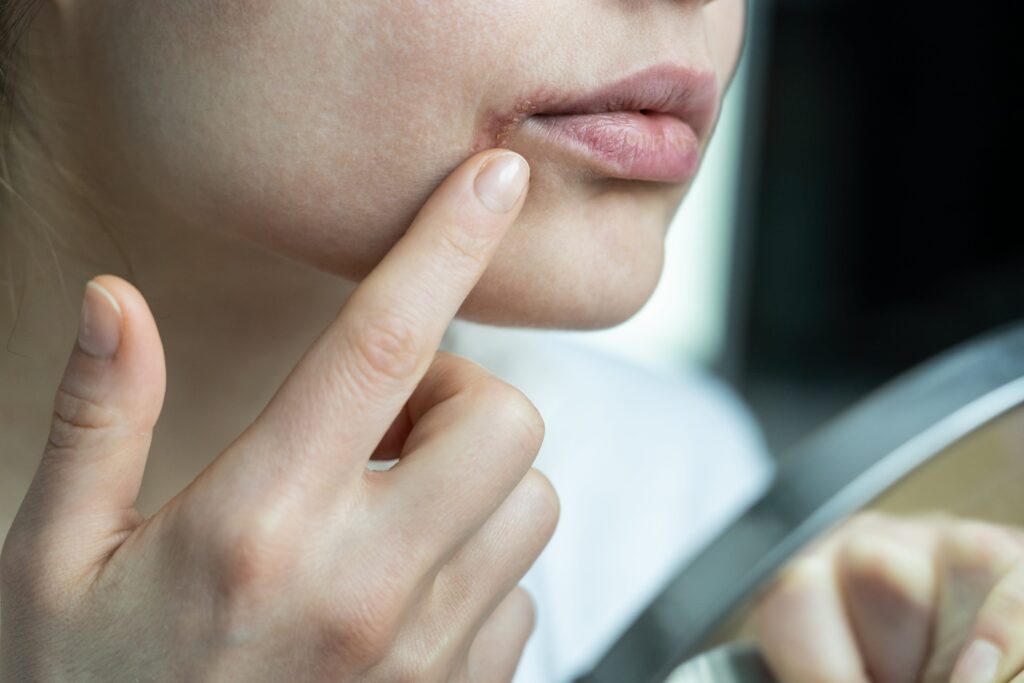
Mouth Herpes (Oral Herpes)
Common signs of an HSV-1 outbreak include the following:
- Tingling or burning before any blister forms
- Fluid-filled blisters that break and crust over within seven to ten days
- Sores inside the mouth or on the gums during a first infection
- Fever and swollen glands in some first-time cases
Genital Herpes
Herpes genital symptoms include sores or blisters on the genitals, inner thighs, or buttocks. Other signs are:
- Pain during urination during active outbreaks
- A first episode that is typically the most severe
- Later outbreaks that are shorter and milder
Sores are often small, atypical, or mistaken for something else. That is a core reason herpes spreads; most people do not recognize their own symptoms.

How Long Does It Take for Herpes to Show Up?
The incubation period for herpes simplex is two to 12 days after exposure, with some cases taking up to 26 days.
In women, a first outbreak may look like genital sores, itching, burning, and pain during urination. In men, blisters around the genitals and local swelling are common. Either way, the first episode is usually the worst.
Is Herpes Curable?
No. Herpes simplex has no cure. Once the virus enters sensory nerve cells, it stays there. However, treatment can help patients manage the infection.
Antiviral medications like acyclovir, valacyclovir, and famciclovir interrupt viral replication. With consistent use, these medications:
- Reduce how often outbreaks occur
- Shorten and soften individual episodes
- Lower transmission risk to partners
Many with herpes live normally, but it is recommended that patients seek and maintain regular medical supervision.
When Should You Get Tested for Herpes?
Get tested if:
- You have blisters, sores, or unusual skin changes around the mouth, genitals, or buttocks
- You have had sexual contact with someone diagnosed with herpes or another STI
- You are starting a new sexual relationship
- You are pregnant with a history of or recent exposure to herpes
- You want a routine sexual health screen
Testing involves a blood draw to detect HSV antibodies or a swab of an active sore. A blood test identifies whether you carry HSV-1, HSV-2, or both, with or without symptoms.
What to Expect From Your Consultation at H.U.M. Clinic
The process is straightforward. Most visits, from registration to testing, take under 30 minutes.
- Book or walk in: Appointments can be scheduled via LINE, WhatsApp, or phone. Walk-ins accepted.
- Anonymous registration: No passport or ID required. You can register under any name.
- Consultation: A physician reviews your symptoms and exposure history, then recommends the right tests.
- Testing: Depends on your situation. HSV can be tested via blood test or PCR from an active lesion; your doctor will advise which applies.
- Results: Same-day for rapid tests. PCR results within one to three business days. Delivered by email, LINE, or in-person pickup.
- Treatment and follow-up: If treatment is needed, it is provided on the same visit. Your doctor will outline the next steps.
All consultations are fully confidential at our comfortable facility.
Get Tested at H.U.M. Clinic
Herpes simplex is common, often silent, and lifelong. Many people carry it for years without a single symptom. Antiviral treatment reduces outbreaks and lowers transmission risk, but getting your diagnosis is the first step.
H.U.M. Clinic specializes in sexual health and evidence-based care. Every consultation is built around your needs. For better insight into your sexual health, book your same-day STD test Bangkok by contacting us via LINE, WhatsApp, phone at 098 983 2949, or email at [email protected].
References
- Herpes simplex virus. (2025, May 30). World Health Organization. Retrieved March 2026, from https://www.who.int/news-room/fact-sheets/detail/herpes-simplex-virus
- Over 1 in 5 adults worldwide has a genital herpes infection. (2024, December 11). World Health Organization. Retrieved March 2026, from https://www.who.int/news/item/11-12-2024-over-1-in-5-adults-worldwide-has-a-genital-herpes-infection-who
- Whitley R, Baines J. Clinical management of herpes simplex virus infections: past, present, and future. (2018). F1000Research. Retrieved March 2026, from https://pmc.ncbi.nlm.nih.gov/articles/PMC6213787/
- Herpes simplex type 1. (2023). StatPearls / NCBI Bookshelf. Retrieved March 2026, from https://www.ncbi.nlm.nih.gov/books/NBK482197/
- Herpes simplex type 2. (2024). StatPearls / NCBI Bookshelf. Retrieved March 2026, from https://www.ncbi.nlm.nih.gov/books/NBK554427/
- Transmission of the herpes simplex virus in the preclinical phase of disease progression during childbirth. (2023, March 13). JMA Journal / PMC. Retrieved March 2026, from https://pmc.ncbi.nlm.nih.gov/articles/PMC10169254/
- Sharma D, et al. An insight into current treatment strategies, their limitations, and ongoing developments in vaccine technologies against herpes simplex infections. (2023). Vaccines / PMC. Retrieved March 2026, from https://pmc.ncbi.nlm.nih.gov/articles/PMC9966607/
- Herpes simplex virus (HSV): types, symptoms, and treatment. (2025, December 15). Cleveland Clinic. Retrieved March 2026, from https://my.clevelandclinic.org/health/diseases/22855-herpes-simplex
Frequently Asked Questions About Herpes Simplex
1) What does herpes look like?
Small, fluid-filled blisters that break open and crust over. Around the mouth, these are called cold sores. On the genitals, sores can appear on the vulva, penis, scrotum, or buttocks. Tingling or itching often comes first, before anything is visible. Many people with herpes never see obvious symptoms, which is a key reason the virus spreads so widely.
2) Is herpes curable?
No. Herpes simplex has no cure. The virus stays in the nervous system permanently. Antiviral medications like acyclovir and valacyclovir can reduce outbreak frequency, shorten episodes, and lower transmission risk. They do not eliminate the virus. With consistent treatment and medical follow-up, most people manage the condition without significant disruption to daily life.
3) How long does it take for herpes to show up in a woman or a man?
Typically two to 12 days after exposure, though some cases take up to 26 days. For women, a first outbreak may include genital sores, itching, and pain during urination. For men, blisters and local swelling around the genitals are common. In both cases, many infections never produce visible symptoms, so the absence of sores does not confirm you are uninfected.
4) If I slept with someone with herpes, do I have it?
Not automatically. Risk depends on whether active sores or viral shedding were present, the type of contact, whether a condom was used, and whether the infected partner was on suppressive therapy. Herpes can spread without visible symptoms, so exposure does not guarantee transmission, but it does warrant a blood test. HSV antibody testing gives you a clear answer.

Provides diverse medical services, specializing in male hormone treatment, sexual health, and general practice care. He is dedicated to delivering comprehensive care for international patients, addressing physical, emotional, and mental health needs.