

Key Takeaways
Syphilis develops in four stages, from a single painless sore to a body-wide rash, and it can stay silent in the body for years without treatment. A blood test is the only reliable way to confirm an active infection, since early signs are easy to miss or mistake for something harmless. If you have had unprotected sex or noticed a new sore or rash, a same-day STD test in Bangkok at H.U.M. Clinic gives you fast, confidential answers.
Syphilis is stealthy, progressing for long periods without causing any noticeable discomfort. A single sore might heal on its own within weeks, only for a body-wide rash to appear months later. Long stretches with no symptoms at all can follow, sometimes for years.
That shifting pattern is what makes syphilis so easy to miss, and so easy to pass on unknowingly. Whether you have noticed something unusual or had a recent exposure, knowing what to watch for and when to get a test helps you protect yourself.
What Is Syphilis and How Does It Spread?
Syphilis is a sexually transmitted infection caused by the bacterium Treponema pallidum. You can get syphilis through direct contact with a sore during vaginal, anal, or oral sex. Sores can appear on the genitals, in the rectum, or in or around the mouth.
The infection can also pass from a pregnant woman to her baby, a form known as congenital syphilis.
You do not need to see or feel a symptom to spread syphilis. Sores are usually firm, round, and painless, so they often go unnoticed. That means someone can transmit the infection during the early stages without ever realizing they had been infected.
The Four Stages of Syphilis
Every syphilis stage brings its own signs, or a complete lack of them.
Primary Syphilis
Primary syphilis usually begins with a single sore, called a chancre, at the site of infection. The sore typically appears about 3 weeks after exposure, though the incubation period can range from 10 to 90 days. It is usually firm, round, and painless. The chancre heals on its own within 3 to 6 weeks even if you did not receive treatment.
Secondary Syphilis
If primary syphilis goes untreated, secondary syphilis can follow.
Common symptoms include a skin rash, referred to as the syphilis rash, that frequently shows up on the palms of the hands and the soles of the feet and is usually not itchy. Other symptoms include swollen lymph nodes, fever, sore throat, patchy hair loss, and mouth sores. These symptoms fade on their own too, but the infection stays active in the body.
Latent Syphilis
Latent syphilis has no visible signs or symptoms at all. Infection can remain in the body for years without treatment, and blood testing is the only way to detect it at this stage.
Tertiary syphilis
Tertiary syphilis is rare and non-contagious, but severe. It is the final stage of the disease, which can develop 10 to 30 years after the original infection and may damage the heart, blood vessels, brain, and nervous system.
What Does Syphilis Actually Look Like?
An early sore usually has firm, raised edges and causes no pain, which is why people often mistake it for an ingrown hair or a harmless bump.
The syphilis rash that shows up during the secondary stage tends to appear on the torso, arms, legs, palms, and soles. It rarely itches, and its appearance can vary quite a bit from person to person.
A physical exam alone cannot confirm or rule out syphilis; laboratory testing is required.
When Should You Get Tested for Syphilis?
Standard blood tests generally need 3 to 6 weeks after exposure before they can reliably detect an active infection, so testing too soon can produce a false negative.
If you are unsure how long to wait, testing between 1 and 3 months after a potential exposure gives the most accurate result.
If you notice a new sore, rash, or other symptom, do not wait for a scheduled test date. See a doctor for an evaluation as soon as possible. Beyond symptoms, screening depends on sexual activity. It is recommended that you get a syphilis screening every 3-6 months if you have been sexually active with new or multiple partners.
Diagnosing Syphilis: Tests and Timing
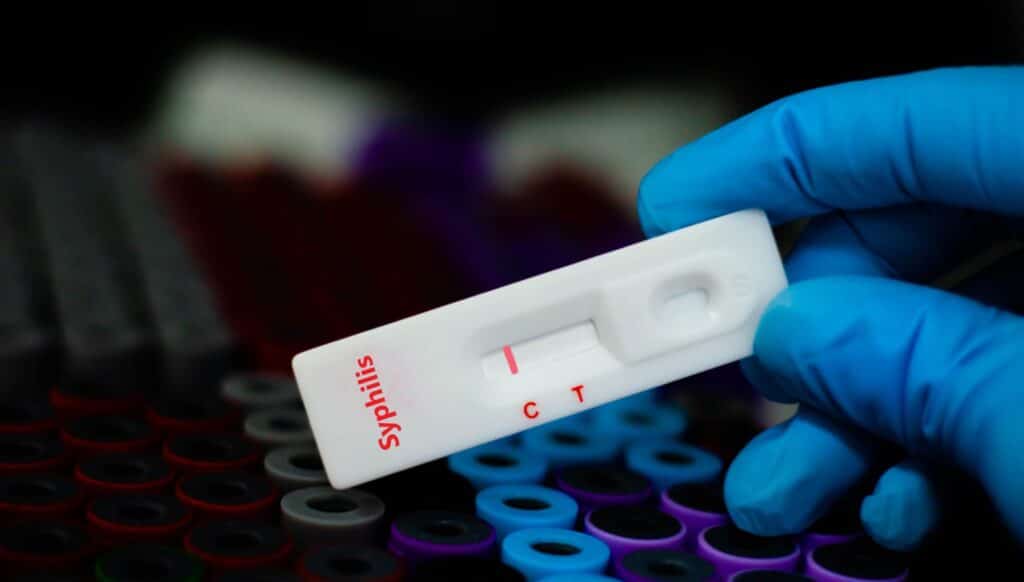
Doctors diagnose syphilis mainly through a blood test for antibodies to Treponema pallidum. In some cases, a doctor may also test fluid from a sore directly.
Two types of blood tests are typically used together to confirm the stage and activity of the infection. A nontreponemal test, such as RPR or VDRL, screens for signs of infection and tracks how active it is. A treponemal test, such as TPPA or FTA-ABS, then confirms the result by detecting antibodies specific to the syphilis bacterium.
A confirmed diagnosis usually requires both, since the screening test alone can produce false positives.
Treating Syphilis with Penicillin
Penicillin is the preferred treatment at any stage. Dosing depends on how long you have had the infection.
- Early syphilis (the primary, secondary, and early latent stages) is treated with a single injection of benzathine penicillin G, 2.4 million units.
- Late latent syphilis, or infection of unknown duration, requires three injections given one week apart.
Treatment clears the infection, but it cannot undo damage that has already occurred, which is another reason early diagnosis is important.
Side Effects of Syphilis Treatment
Treatment comes with a common short-term reaction, and knowing about it in advance prevents a needless scare. Within the first 24 hours of the first dose, some people notice a brief flu-like reaction as the body responds to the dying bacteria. This is the Jarisch-Herxheimer reaction, and it typically involves:
- Fever, chills, headache, and muscle aches that appear soon after the injection.
- Symptoms that settle on their own within a day, helped by rest and fever medication.
- Mild soreness at the injection site.
This reaction is a response to the treatment, not an allergy to penicillin. Tell your doctor if symptoms are severe or do not ease. After treatment, follow-up blood tests confirm that the infection has cleared.
Testing is repeated at 6 weeks and 3 months for patients with ongoing exposure risk. It is recommended to avoid sexual activity until treatment is complete, and any sexual partners should be tested and treated at the same time. Having syphilis once does not protect you from getting it again.
Get Same-Day STD Testing in Bangkok
Most testing splits into two trips: one to give a sample, another to hear the result, with several days of feeling uneasy in between.
Same-day testing reduces the wait and stress. You walk out with an answer instead of needing to spend another week wondering. Fast diagnosis also allows for early treatment, which helps outcomes.
A same-day STD test in Bangkok at H.U.M. Clinic pairs a doctor’s assessment with rapid laboratory results, so diagnosis and a treatment plan can take place in a single visit.
Our doctors bring over 8 years of experience in sexual health and STD care. Testing is discreet, with English-speaking doctors available. To book a same-day STD test in Bangkok, contact us via LINE, WhatsApp, phone at 098 983 2949, email at [email protected], or visit our facility located a short distance from BTS Asok and MRT Sukhumvit.
References:
About Syphilis. Retrieved July 7, 2026, from https://www.cdc.gov/syphilis/about/index.html
Syphilis – CDC Fact Sheet. Retrieved July 7, 2026, from https://stacks.cdc.gov/view/cdc/133600/cdc_133600_DS1.pdf
CDC Laboratory Recommendations for Syphilis Testing, United States, 2024. Retrieved July 7, 2026, from https://www.cdc.gov/mmwr/volumes/73/rr/rr7301a1.htm
Serological Tests for Syphilis. Retrieved July 7, 2026, from https://pmc.ncbi.nlm.nih.gov/articles/PMC6896393/
Syphilis. Retrieved July 7, 2026, from https://pmc.ncbi.nlm.nih.gov/articles/PMC2563895/
What is the Syphilis Testing Window? Retrieved July 7, 2026, from https://www.getmaple.ca/blog/what-is-the-syphilis-testing-window/
Frequently Asked Questions About Syphilis (FAQs)
Q: What does syphilis look like?
A: Syphilis can look different at every stage. The first sign is often a single, painless sore with firm edges, and the secondary stage can bring a non-itchy rash on the palms, soles, or torso. Because symptoms vary so much, a visual check cannot confirm or rule out syphilis. Only a blood test can.
Q: What are the symptoms of syphilis?
A: Symptoms depend on the stage. Primary syphilis usually causes one painless sore, while secondary syphilis can bring a rash, fever, swollen lymph nodes, and fatigue. Latent syphilis has no symptoms at all, and tertiary syphilis, which is rare, can affect the heart, brain, and nervous system years later.
Q: How is syphilis transmitted?
A: Syphilis spreads through direct contact with a syphilis sore during vaginal, anal, or oral sex. It can also pass from a pregnant woman to her baby. A person can transmit syphilis even without noticing any symptoms themselves.
Q: How soon can you test for syphilis?
A: Blood tests for syphilis generally become reliable 3 to 6 weeks after exposure. Testing too early can miss a new infection, so retesting up to 3 months after exposure is recommended if your first test comes back negative and risk remains.
Q: How soon after unprotected sex can I test for an STD?
A: Testing windows vary by infection. Chlamydia and gonorrhea can often be detected within 1 to 2 weeks, HIV usually needs 2 to 6 weeks, and syphilis typically takes 3 to 6 weeks after exposure. A doctor can help you build the right testing timeline for your specific situation.
Q: How long to wait after syphilis treatment before retesting?
A: Your doctor will typically schedule follow-up blood tests at 6 weeks and again at 3 months after treatment. These tests confirm that treatment worked and that antibody levels are dropping as expected.

Provides diverse medical services, specializing in male hormone treatment, sexual health, and general practice care. He is dedicated to delivering comprehensive care for international patients, addressing physical, emotional, and mental health needs.